⭐⭐⭐⭐⭐930+ Happy Customer Reviews

A lawn sprinkler system works one zone at a time. The controller sends a 24-volt signal to a zone valve, the valve opens, pressurized water flows through buried pipe, and pop-up heads spray until the run time ends. Then the valve closes and the next zone starts. That single sentence explains almost every system you will see in a Palm Coast yard. The rest of this guide walks the same path slowly — source, backflow preventer, controller, valve, pipe, head — so that when something goes wrong, you know which part to look at first.
Key takeaways: Zones run one at a time, never all at once. The controller only sends a low-voltage signal; it does not move water. A valve opens because pressure above its diaphragm is released. Florida law requires a working rain or soil-moisture sensor on systems installed after May 1, 1991, and watering is barred between 10 a.m. and 4 p.m. — check the current district schedule before you set a timer.
Every residential lawn system has the same five parts, however fancy the controller looks. First, a water source: city water, a shallow well with a pump, or reclaimed water. Second, a backflow preventer, which stops irrigation water flowing back into the drinking supply — it sits above ground, so it is the part most exposed to a hard freeze. Third, a controller, the box in the garage that holds the schedule and sends signals. Fourth, zone valves, usually grouped in a green box in the yard. Fifth, pipes and heads: the mainline that stays pressurized, laterals that carry water only while their zone runs, and the heads that throw it onto the grass. Our components guide describes each part in detail; here, the focus is on how they work together.
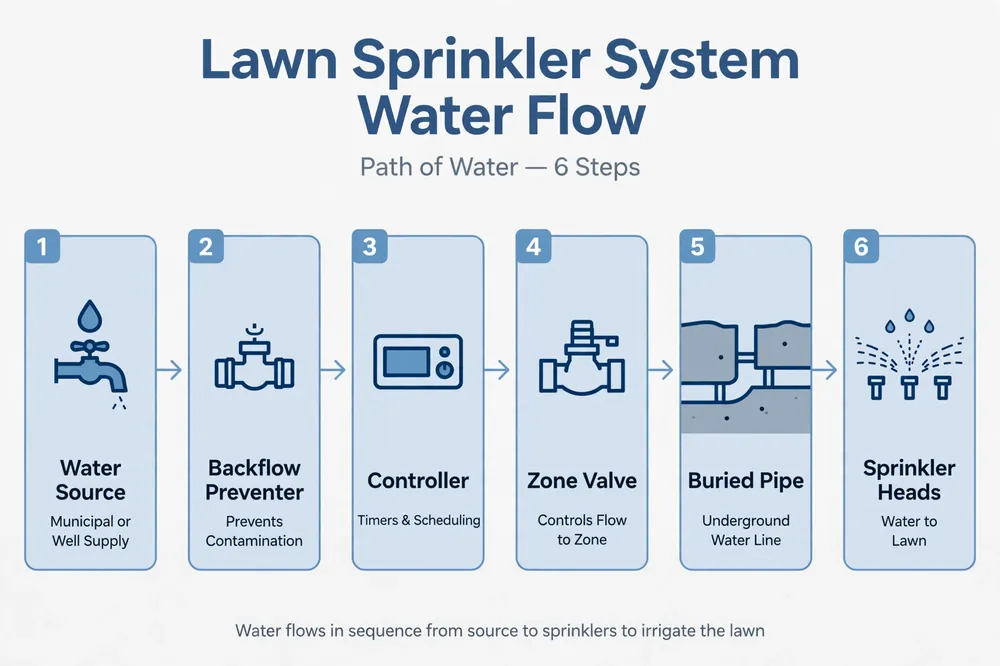
Follow one watering cycle from start to finish, on a typical Palm Coast system fed by a well. 1. The controller wakes up. At the programmed start time it checks its schedule and, if a rain sensor is wired in, whether that sensor is telling it to skip.
2. The pump starts. On a well system the controller energizes a pump start relay, which switches the pump on; on city water there is no pump step, because the street pressure is already there.
3. The controller signals zone 1. It sends 24 volts down the zone wire to that zone’s solenoid.
4. The valve opens. The solenoid lifts a small plunger, pressure above the valve’s diaphragm bleeds away, and water pressure underneath pushes the diaphragm open — the mechanics are explained in the next section.
5. Heads pop up and spray. Pressure in the lateral rises, pop-up stems lift, and the heads throw water for the programmed run time.
6. The valve closes and the next zone starts. The controller drops the signal, the diaphragm reseats, the heads drop back into the ground, and zone 2 begins.
When the last zone finishes, the pump relay drops out and the system sits quiet until the next scheduled day. If a head is dry while its neighbours spray, the fault is in that zone’s valve, wire, or pipe — not in the controller as a whole.
A zone valve has no motor and no handle you turn. Inside it sits a rubber diaphragm sealing the water passage, with a small chamber of water above it holding it shut. When the controller sends 24 volts to the solenoid — the small cylinder on top of the valve — the solenoid lifts a plunger and opens a tiny bleed port. Water above the diaphragm escapes, pressure above it falls, and higher pressure below pushes it open. When the signal drops, the plunger reseats, the chamber refills, and pressure pushes the diaphragm shut again.
That is why a speck of sand in the bleed port can leave a valve open and flood a zone: the diaphragm never gets the pressure it needs to reseat. If your valve box holds standing water, our valve box guide explains what to check, and if a zone will not start at all, the solenoid itself is a common suspect — see our solenoid replacement guide.
Zones exist because water supply is finite. A typical home supply — city meter or well pump — can deliver only so many gallons per minute at usable pressure. Put twenty heads on one circuit and pressure at the far end collapses: near heads mist, far heads dribble, nothing waters evenly. Splitting the yard into zones, each with a head count its supply can actually feed, keeps pressure up.
Zones also follow the yard: sunny front lawn, shaded side strip, and shrub beds each need different run times, and head types are never mixed on one zone because a rotor and a spray head apply water at very different rates. Our zones guide works through the sizing logic; the short version is that more zones is not a flaw, it is how an even lawn is made.
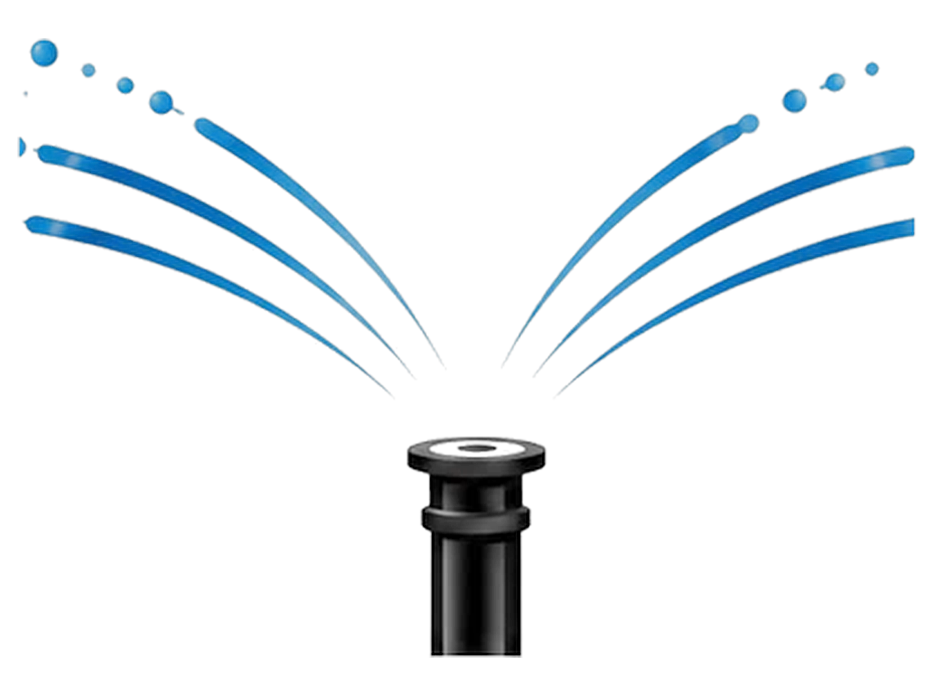
Heads are not interchangeable, and the difference shows up in coverage and run time. A fixed spray head pops up a few inches and throws a fixed fan over a small area — good for narrow strips, but it puts water down fast, so its runs are short. A rotor turns a single stream slowly across a larger arc — good for open lawn, slower application, longer runs. A rotary nozzle sits between the two, throwing multiple rotating streams for more even medium-area coverage.
Drip is different altogether: emitters release water drop by drop at the soil surface, for beds and shrubs, not lawn. Mixing types on one zone guarantees uneven watering, because the zone runs for one length of time. For beds specifically, our automatic garden sprinkler guide covers drip layouts, and our sprinkler vs drip comparison sets out when each one earns its place.
| Head type | Best for | Coverage | Application rate |
|---|---|---|---|
| Fixed spray pop-up | Small lawns, narrow strips | Short radius, fixed fan | Fast — short runs |
| Rotor | Open lawn | Large arc, single stream | Slow — longer runs |
| Rotary nozzle | Medium lawn areas | Medium radius, rotating streams | Moderate — even coverage |
| Drip emitter | Beds, shrubs, trees | Point delivery at soil | Very slow — long, infrequent runs |
Palm Coast yards run on three supplies, and the supply changes how the system behaves. City water arrives already pressurized from the street, so no pump is needed; the backflow preventer is still mandatory. Well water is the common Palm Coast setup: a shallow well with a pump, started by the controller through a pump start relay, and — on tank systems — a pressure switch that tells the pump when to run.
A companion guide on checking an irrigation pump pressure switch is planned; the key point is that a pump that never starts is a relay or switch problem before it is a controller problem. Reclaimed water is treated wastewater for irrigation, with its own backflow requirements and purple-marked components; it is not drinking water and must never be cross-connected with a potable line. Whichever supply you have, the rest of the cycle works the same way.
A basic timer does exactly what it is told: start at this time, run zone 1 for this many minutes, then zone 2, on these days. It does not know whether it rained yesterday, and it will water a soaked lawn unless a sensor stops it. A smart controller adds weather to the decision: it pulls local weather data or reads a soil-moisture sensor, skips cycles after rain, and adjusts run times with the season. Both obey the same Florida rules.
Under Florida Statute 373.62, any automatic landscape irrigation system installed after May 1, 1991 must have a working rain or soil-moisture sensor that overrides the schedule — a bypassed, painted-over, or dead-battery sensor is not a working sensor. On top of that, St. Johns River Water Management District rules limit watering days and prohibit watering between 10 a.m. and 4 p.m.; the exact day schedule changes with the season, so check the current schedule rather than relying on a remembered rule.
The phrase “residential sprinkler system” causes a genuine mix-up in search results, so the distinction is worth one paragraph. A lawn sprinkler system waters grass on a schedule, outdoors, through buried pipe and pop-up heads, and it runs on a controller.
A residential fire sprinkler system sits inside a house, connected to the plumbing, and does nothing at all until heat from a fire opens a single sprinkler head above the flames — it has no controller, no zones, and no schedule. They share a word and almost nothing else. If you arrived here looking for fire protection, this guide is not the one you need; if you want to understand the system watering your lawn, you are in the right place.
Run through this checklist after a cycle, while the evidence is fresh. One zone never runs: suspect its solenoid, its wire, or a controller output. One zone never stops: suspect a valve that will not reseat — sand in the bleed port or a torn diaphragm. Heads pop up but barely spray: suspect low pressure, a partly closed valve, or too many heads on the zone.
One head sprays weakly while its neighbours are fine: suspect a clogged nozzle or a damaged head, not the valve. Water pools around a valve box: suspect a valve or fitting leak. Controller display dark: check its power supply and transformer first. System waters in the rain: the rain sensor is bypassed, failed, or missing. Each points to a single part — which is why understanding the cycle matters: you stop replacing the controller when the fault is a five-dollar nozzle.
Some faults are homeowner jobs — a clogged nozzle, a rain sensor battery, a head raised to the right height. Others are not: a valve that will not close after cleaning, a pump that will not start, a mainline leak you can hear but cannot find, or any work on 240-volt pump wiring. Layout problems — zones sized by guesswork, heads mixed on one zone, coverage drifted as trees grew — will not be fixed by turning a dial. If the checklist points to a valve, a wire, or a supply problem and you are unsure which, get a diagnosis first.
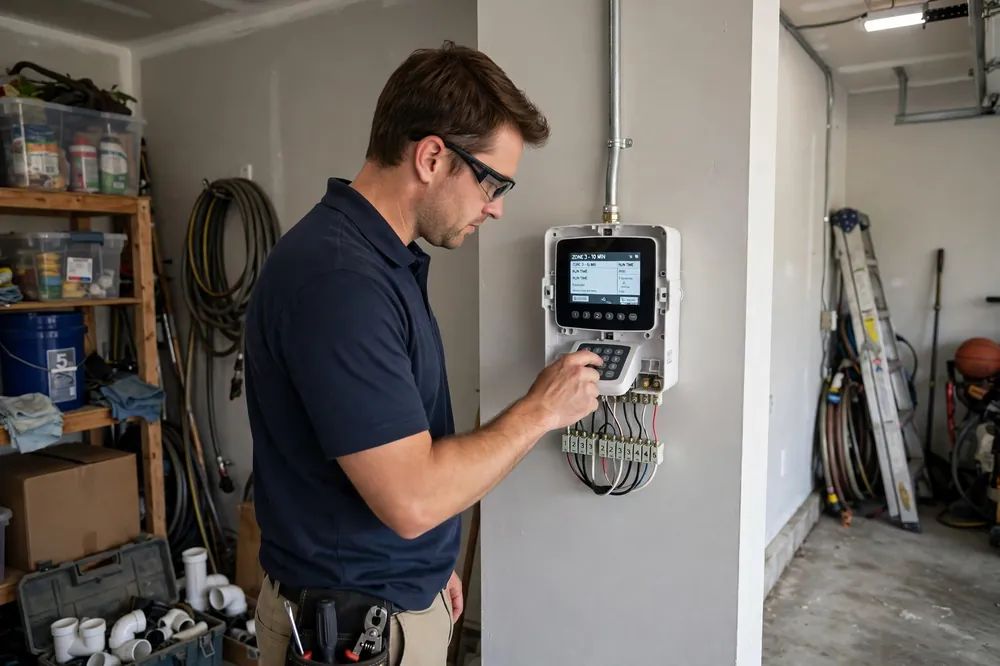
The upgrade question comes up on almost every service call, so here is the honest comparison. A basic timer costs less, is simple to program, and does its job perfectly on a yard where someone watches the weather and adjusts it by hand. A smart controller costs more, needs Wi-Fi and a phone app, and in return skips rainy days, adjusts for the season, and can be checked from anywhere.
It does not fix bad hydraulics: a smart controller on a zone with too many heads still waters unevenly, and it does not replace a rain sensor, which Florida law requires regardless. A companion guide on automating an existing system is planned; this guide stays with how the system works, whatever controller sits on the wall.
A spray head and a rotor on the same zone cannot both be right, because the zone runs for one length of time and the two heads apply water at very different rates. The spray area floods while the rotor area stays dry, or the rotor area is satisfied while the spray area is soaked. If a zone waters unevenly and the heads are a mix, the fix is to separate the types, not to lengthen the run time.
Watering between 10 a.m. and 4 p.m. loses the most water to evaporation and breaks the district’s daytime rule. Watering a little every day trains shallow roots that need even more water, and it keeps the surface constantly wet, which invites fungus. Deep, infrequent watering on your scheduled days, in the early morning, grows deeper roots and a lawn that tolerates a dry spell.
A rain sensor with a dead battery, a coat of paint, or a bypass wire is the same as no sensor at all — and on a system installed after May 1, 1991, it is also a legal gap. Test it once a season: wet the sensor disc and confirm the controller skips its next cycle. If it does not skip, replace or rewire the sensor before you touch any other setting.
Controller wakes on schedule and checks the rain sensor. Well pump starts through its relay, if present. Controller sends 24 volts to zone 1’s solenoid. Solenoid bleeds pressure above the diaphragm, the valve opens, and water flows through the lateral. Heads pop up and spray for the programmed minutes. Valve closes, heads drop, zone 2 starts. Last zone finishes, pump stops, system waits for its next scheduled day. If any step in that chain fails, the symptom tells you where: no signal, no valve; no valve, no water; no pressure, weak spray; no sensor, watering in the rain.
If the checklist points in two directions at once — say, weak spray on every zone, not just one — the fault is upstream of the zones: supply pressure, a mainline restriction, or a pump problem. That is a diagnosis job, not a settings job, and guessing at it by raising run times only masks the cause while the lawn thins. Our sprinkler repair and maintenance pages describe what a technician checks first on a system-wide fault. If the system is sound but the layout is wrong, that is an installation question: see our sprinkler installation page.
We install and service lawn sprinkler systems across Palm Coast, Flagler Beach, Ormond Beach, and Bunnell — controllers, valves, pumps, and zone-by-zone tuning for St. Augustine lawns.
Call (386) 237-2983 for an irrigation inspection: we will run every zone, check the controller, valves, and rain sensor, and tell you what is working, what is not, and what it will take to fix — before you spend on anything else.
A lawn sprinkler system works one zone at a time. The controller sends a 24-volt signal to a zone valve, the valve opens, pressurized water flows through buried pipe, and pop-up heads spray until the run time ends. Then the valve closes and the next zone starts. A fire sprinkler system is entirely different: it sits inside a house and only activates when heat from a fire opens a head.
A basic timer waters on the days and times you program, whether it rained or not, unless a rain sensor overrides it. A smart controller adds weather data or soil-moisture readings and skips cycles after rain. Under Florida law, systems installed after May 1, 1991 must have a working rain or soil-moisture sensor that overrides the schedule.
No. Zones run one at a time, because a home water supply can only deliver enough pressure and flow for one zone’s heads at once. Running two zones together would drop the pressure and leave both zones watering unevenly.
From the source — city water, a well pump, or reclaimed water — through a backflow preventer, then through the mainline to a zone valve. When the controller opens that valve, water flows through the zone’s lateral pipes, pressure lifts the pop-up stems, and the heads spray.
Only if it runs on well water. City water arrives already pressurized, so no pump is needed. A well system needs a pump, started by the controller through a pump start relay, and on tank systems a pressure switch that tells the pump when to run.
Yes, for automatic landscape irrigation systems installed after May 1, 1991, under Florida Statute 373.62. The system must have a working rain sensor or soil-moisture sensor that overrides the watering schedule. A bypassed or dead sensor does not meet that requirement.
It depends on the head type, the soil, and the season. Spray heads put water down fast and run for shorter times; rotors apply it slowly and run longer. As a rule, water deeply and infrequently in the early morning, on your scheduled days, and never between 10 a.m. and 4 p.m. — and check the current district schedule for your watering days.
With maintenance, the buried pipe and valves typically last many years; controllers, solenoids, and heads are the parts replaced most often. The system that lasts longest is the one whose rain sensor works, whose zones are sized for their water supply, and whose heads are not mixed on a single zone. See our guide on how long an irrigation pump lasts for the pump side of that question.