⭐⭐⭐⭐⭐930+ Happy Customer Reviews
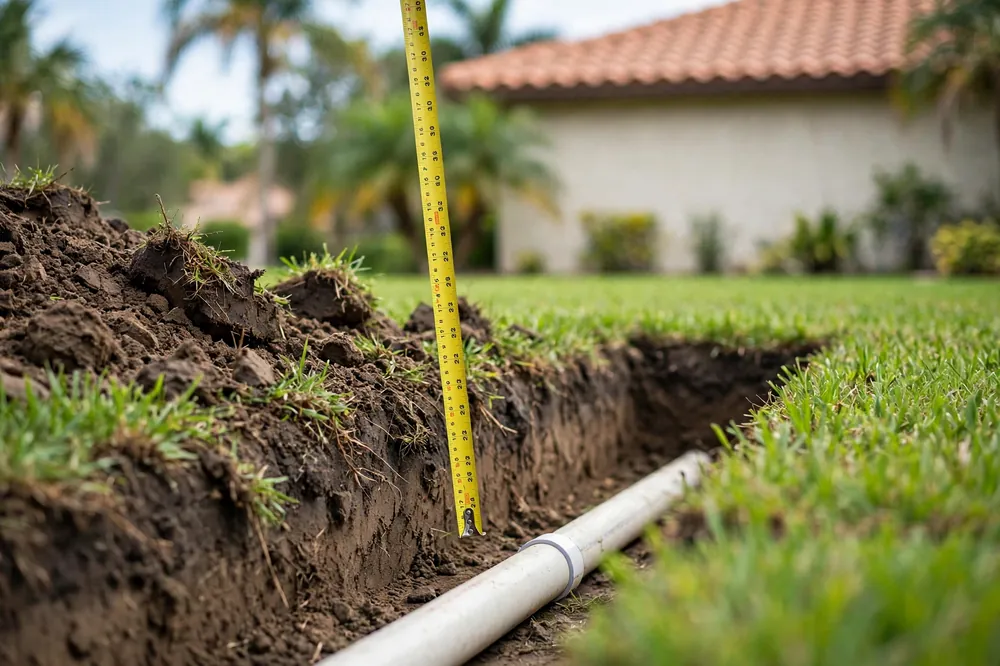
In Florida, small sprinkler pipe (1/2 inch to 1-1/2 inch) needs at least 6 inches of cover, 2-inch to 3-inch pipe needs 12 inches, and any pipe under a driveway needs 18 inches. Most residential laterals sit 6 to 12 inches deep; mainlines go deeper. Depth is measured from finished grade to the top of the pipe.
The table below gives the minimum cover figures from Florida Building Code, Plumbing, Appendix F, exactly as that appendix sets them out. Treat these as minimums, not targets: a line at the minimum is also the line most likely to be nicked by an edger or aerator tine. Palm Coast installers aim a little deeper on laterals, 8 to 12 inches, because the extra inches cost almost nothing at install time and buy real protection later.
| Pipe size | Minimum cover |
|---|---|
| 1/2 inch to 1-1/2 inch | 6 inches |
| 2 inch to 3 inch | 12 inches |
| 4 inch to 6 inch | 18 inches |
| Over 6 inch | 24 inches |
| Any pipe under vehicle traffic areas | 18 inches |
Two things surprise most homeowners here. The jump from 6 to 12 inches happens at 2-inch pipe, larger than most residential laterals ever get. And the vehicle-traffic rule overrides everything else: even a small lateral crossing a driveway needs 18 inches, not 6. If a plan shows a driveway crossing at lateral depth, question that detail first.
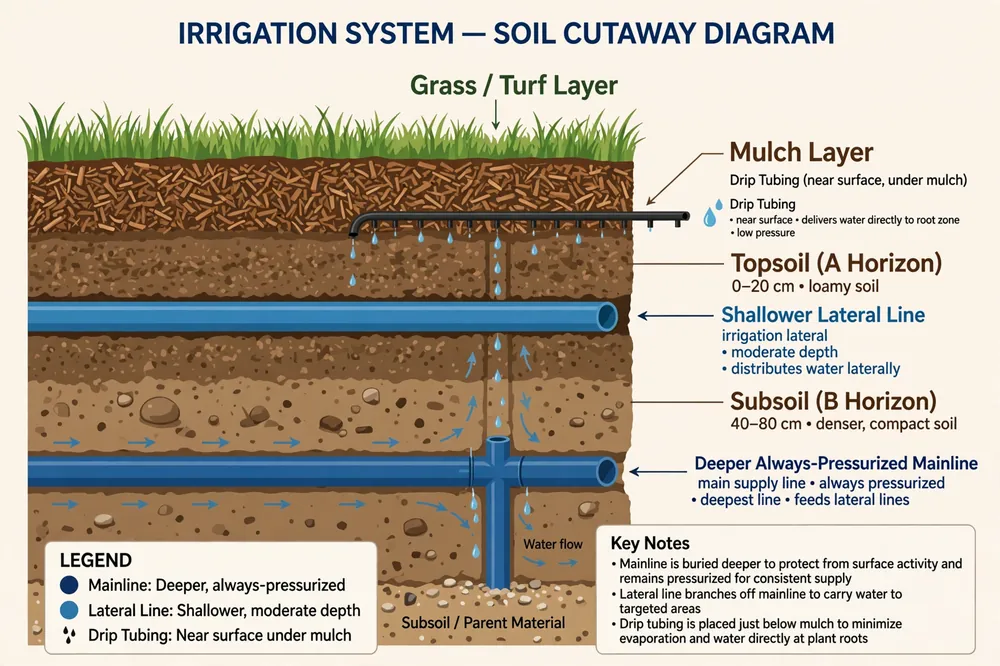
Not every pipe does the same job, so not every pipe sits at the same depth. The mainline runs from the water source to the valve manifold and stays pressurized whenever the system is on, so a break there leaks constantly. Laterals run from each valve to the heads and only carry water while their zone runs. Drip tubing carries low-pressure water straight to plant roots. Our components guide explains each part in more detail.
| Pipe type | Pressure | Typical depth | Why |
|---|---|---|---|
| Mainline | Always pressurized | Deeper than laterals | A pressurized break wastes water until someone notices |
| Lateral | Pressurized only while its zone runs | Mostly 6 to 12 inches | Deep enough to clear mowers, shallow enough to repair |
| Drip tubing | Low pressure | Surface under mulch, or 2 to 4 inches down | It feeds roots directly and must stay reachable |
When tracing a leak or planning a dig, expect the mainline deepest and drip tubing shallowest, sometimes barely under the mulch. Never assume one depth for a whole yard.
Up north, burial depth is mostly about frost: pipe must sit below the frost line or it freezes and splits. Palm Coast has no frost line in that sense, and that changes the calculation. Depth here is not about winter at all. It is about what actually hits buried pipe in a Florida yard: mower and edger blades, core aerator tines, shovel work around beds, tree and shrub roots, and foot traffic.
That does not mean Florida systems ignore cold. The freeze risk here sits above ground: the backflow preventer and any exposed pipe are what a cold night can crack, which is why our winterize guide focuses on those parts rather than on burying pipe deeper.
Pipe size. Bigger pipe, deeper minimum. On a typical residential system the laterals are small pipe, so the 6-inch minimum is the floor, and the installer chooses how far above it to go.
Head height. Pop-up heads come in 4-inch and 6-inch rises, and the head must sit flush with finished grade when retracted. Too high and mowers clip it; too low and it sprays into the grass instead of over it. See our pop-up head guide for what wrong head height looks like.
Sandy soil and settling. Palm Coast sand trenches easily but also shifts and settles. A loosely backfilled trench can sink a few inches in the first season, quietly reducing cover. Backfill compacted in layers matters as much as trench depth.
Tree roots. A lateral near a live oak or palm will meet roots sooner or later, and roots can lift shallow pipe or crush it against a hard spot. Near a large tree, go deeper with a clean, rock-free bed; it is cheaper than digging the run up twice.
Vehicle areas. Any pipe under a driveway or parking pad needs the 18-inch vehicle-traffic cover plus a sleeve, covered in the next section. This is the one place the minimum is not negotiable.
Backfill rule. The same code appendix bars rocks over 1 inch in the first 6 inches above the pipe. A rock on a PVC lateral is a pressure point that takes the load every time a mower or car passes. Screen the first backfill, or use clean sand, and save rough spoil for the top of the trench.
A sleeve is a larger empty pipe laid under paving before the paving goes down, so the working pipe can be pulled through it later without cutting concrete or pavers. Without a sleeve, a broken line under a driveway means cutting the driveway. With one, it means pulling a new pipe through an existing tube.
The rules from the same code source are straightforward: the sleeve should be two pipe sizes larger than the pipe it carries, extend 3 feet past the paving on each side so its ends sit in soil rather than under the slab edge, and be Schedule 40 pipe at minimum, not thin-wall pipe that can oval or crush under load. Mark the sleeve ends on the installation plan, because a sleeve nobody can find is barely better than no sleeve.
If your driveway already exists with no sleeve, adding a line under it means boring beneath the paving or cutting it. Price that with an installer before anyone digs: a professional installation puts the sleeve in nearly free while the driveway is open, and it is expensive forever after.
| What happens | What it costs you | |
|---|---|---|
| Too shallow | Mower, edger, and aerator damage; UV damage where pipe surfaces; roots lift pipe into the cutting zone | Repeat leaks, wet patches, and repair calls for the same line |
| Too deep | Repairs mean a bigger dig; locating a line takes longer; no real benefit in a no-frost climate | Higher repair bills and longer downtime for every future fix |
Shallow lines announce themselves: a wet stripe after mowing, a head spraying sideways, or a zone losing pressure the day after edging. If that sounds familiar, our leak detection guide walks through finding the break before it becomes a washed-out trench. Deep lines fail more quietly, and the bill arrives as digging time. For most residential laterals, 8 to 12 inches is the compromise between those two failure modes.
Before any digging — planting a tree, putting in a fence, or trenching a new lateral — call Sunshine 811 at least two full business days ahead. Utility lines in a Florida yard can sit just a few inches down, far shallower than most people expect. A locate visit marks gas, electric, telecom, and water lines so you can work around them instead of through them.
Two full business days is a minimum, not a target: call earlier on a bigger job, and do not start if marks are unclear or a utility has not responded. This applies to hand digging as well as machine trenching. A shovel finds a buried cable just as effectively as a trencher.
Start at the valve boxes. Each zone’s lateral runs from its valve out toward its heads, so following the heads back toward the box usually traces the run well enough to plan around. Run one zone at a time and watch: wet spots, sputtering heads, or a line of greener grass can all mark a lateral’s path, and a zone that will not hold pressure points to a break along it.
For a more exact trace, a wire tracer clipped to the zone wire follows the wire path, which usually runs beside the pipe in the same trench. It is not perfect — wire and pipe can separate around obstacles — but it beats guessing. When the line must be found exactly, for a driveway cut or fence post line, call a pro rather than probing with a shovel: a probe finds pipe by hitting it, which is the damage you were trying to avoid.
Trenching opens a narrow ditch, lays the pipe in it, and backfills. It is precise: depth is visible and checkable, backfill can be screened, and sleeves go in exactly where planned. The cost is lawn disruption — a trench line across turf takes weeks to disappear, and in a bed it means re-mulching the run.
Pulling, or vibratory plowing, drags pipe through the soil with a blade, leaving a slit rather than an open ditch. It is faster and far less disruptive to an established lawn, but depth control is less exact, and you cannot inspect the pipe bed or screen backfill the same way. In sandy Palm Coast soil both methods work; the choice comes down to how much disruption you will accept against how exact the depth and bedding must be. Either way, ask how depth will be verified before the trench or slit is closed — after backfill, nobody can check it without digging it up again.
Call a pro when the line runs under paving, utilities are near the dig, a mainline is involved, or one shallow line suggests the rest was installed the same way. A system-wide depth problem needs a survey and a plan, not a single repair. Our design guide explains proper layout, and our cost guide gives a sense of what new work runs.
A good install is checkable: trench depth measured before pipe goes in, a rock-free pipe bed, no rocks over 1 inch in the first 6 inches of backfill, sleeves two sizes larger and Schedule 40 sticking out 3 feet past paving, heads flush with grade, and a note of where the mainline and sleeves ended up.
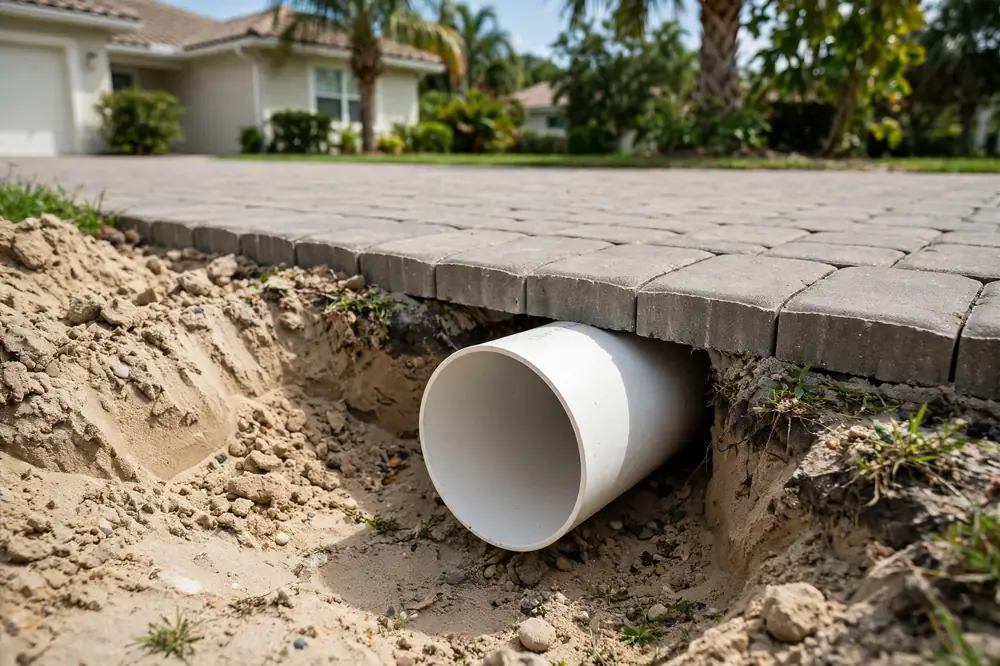
A lateral under paving with no sleeve saves an hour at install time and costs a driveway cut at repair time. Price any unsleeved crossing as a boring or cutting job before approving it.
Rough spoil straight back onto pipe creates pressure points that fail under load. Screen the first 6 inches above the pipe and use clean sand if the spoil is rocky.
Shallow utility lines get cut every year by people sure they knew where everything was. Two full business days and one free call remove that risk.
| Situation | Depth to remember |
|---|---|
| Small residential lateral (1/2 to 1-1/2 inch) | At least 6 inches of cover; 8 to 12 inches is the usual install range |
| 2-inch to 3-inch pipe | At least 12 inches of cover |
| Any pipe under a driveway or vehicle area | At least 18 inches of cover, in a sleeve |
| Drip tubing | Surface under mulch, or 2 to 4 inches down |
| Backfill over any pipe | No rocks over 1 inch in the first 6 inches above the pipe |
Before planting trees, fencing, or adding a patio over irrigated ground, find the lines first: a locate visit, a zone-by-zone run, and a look at the valve boxes, plus a professional survey if needed. The yard looks empty; it is just buried.
We install and repair irrigation systems across Palm Coast and Flagler County — trenching and pulling, sleeves under driveways, and depth checks on existing systems.
Call (386) 237-2983 for an inspection: we will trace your lines, check depths and sleeves, and tell you which runs are safe to dig near.
Most residential lateral lines sit 6 to 12 inches deep in Florida. Small pipe (1/2 inch to 1-1/2 inch) needs at least 6 inches of cover under Florida Building Code, Plumbing, Appendix F, and most installers aim for 8 to 12 inches for extra protection against mowers and edgers.
No. Palm Coast has no frost line in the northern sense, so depth here protects against mowers, aerators, roots, and foot traffic, not freezing. The freeze risk in Florida sits above ground, in the backflow preventer and exposed pipe, not in buried laterals.
Deeper than laterals. The mainline stays pressurized all the time, so a break leaks continuously, and it usually carries larger pipe, which carries a deeper minimum cover under the code table: 12 inches for 2-inch to 3-inch pipe, and 18 inches for 4-inch to 6-inch pipe.
Drip tubing sits on the surface under mulch, or 2 to 4 inches down. It is low-pressure tubing meant to be reached and adjusted, so burying it at sprinkler-pipe depth would only make maintenance harder. See our drip installation guide for the full layout.
Yes. Lines with less than 6 inches of cover get nicked by mowers and edgers, damaged by aerator tines, and lifted by roots into the cutting zone. A wet stripe after mowing or a zone that loses pressure after edging are classic signs of a line that is too shallow.
At least 18 inches of cover, in a sleeve two pipe sizes larger than the pipe it carries, extending 3 feet past the paving on each side, in Schedule 40 pipe at minimum. Without a sleeve, a broken line under a driveway means cutting the driveway to reach it.
Yes. Call Sunshine 811 at least two full business days before any digging, including hand digging. Utility lines in a Florida yard can sit just a few inches down, and a locate visit marks them so you can work around them instead of through them.