⭐⭐⭐⭐⭐930+ Happy Customer Reviews

Yes — if you live in North or Central Florida. While South Florida rarely freezes, Palm Coast and the surrounding counties see freezing temperatures most winters — wind chills dropped into the 20s here in January 2025. Winterizing means shutting off the water, draining the lines and backflow preventer, and setting the controller to rain mode. It’s a 30-minute job that prevents $500 to $5,000 in freeze repairs.
Key takeaways:
Search “how to winterize a sprinkler system” and every national guide assumes you live somewhere with real winters — Minnesota, Colorado, New England. Some even say Florida (zones 9-10) can skip winterization entirely. That advice is dangerously incomplete if you live anywhere north of Orlando.
Here’s what actually happened recently: in January 2025, an Arctic blast pushed wind chills into the 20s across Flagler and Volusia counties, and the National Weather Service issued cold-weather advisories for our area. November record lows in Northeast Florida dip into the low 30s. It doesn’t take a week of subzero weather to destroy an irrigation system — a single night in the 20s will crack an above-ground backflow preventer and split shallow PVC lines.
The honest breakdown:
Florida winterization also looks different from the northern version. You’re not fighting months of frozen ground — you’re protecting against short, sharp freeze events. That means the priorities shift: draining standing water, insulating the above-ground backflow assembly, and putting the controller in rain mode matter more than an aggressive high-PSI blowout.
The universal rule is simple: winterize before the first freeze. In Northeast Florida, that means aiming for mid-November — comfortably ahead of the late-November and December cold snaps.
Here’s a timing trick our technicians use: tie winterization to the St. Johns River Water Management District’s “fall back” schedule. On the first Sunday in November, when clocks fall back, the District drops residential watering to one day per week and keeps the year-round 10 a.m. to 4 p.m. watering ban in place. Do your timer reset, rule check, and freeze prep in one visit — it’s the natural moment in the Florida irrigation calendar.
Between scheduled prep and real weather, watch National Weather Service freeze watches. When an advisory posts for Flagler County, you have days — not weeks — to get the backflow preventer drained and insulated. That single task prevents the most expensive freeze repair we see.
There are three ways to get water out of your system. Which one fits depends on how your system was built:
| Method | How it works | Cost | Difficulty | Best for |
|---|---|---|---|---|
| Air blowout | Compressed air forces water out zone by zone | $75-$150 pro; compressor rental ~$50-$80/day | Medium (PSI discipline required) | Most thorough option; systems without drain valves |
| Manual drain | Open drain valves at the system’s low points; gravity does the work | Free | Easy | Systems built with manual drain valves |
| Automatic drain | Auto-drain valves open when pressure drops | Free (built in) | Easy (verify they work) | Systems equipped with auto-drain valves |
The blowout is the gold standard — an air compressor connected to the system pushes water out of every zone until only mist comes from the heads. The critical safety rule: never exceed 50 PSI for poly pipe or 80 PSI for PVC. More pressure doesn’t mean drier pipes — it means cracked fittings. And CFM (air volume) matters more than tank size; those small pancake compressors most homeowners own usually can’t move enough air, which is why the blowout is the job most often handed to a pro.
Manual drain works if your installer included drain valves at the low points — open them, let gravity empty the lines, and leave them open. Automatic drain valves do this on their own whenever pressure drops, but verify they’re actually working (a stuck auto-drain is the same as no drain).
The Florida reality: many Florida systems were installed in sandy soil without drain valves at all — installers skipped them because “it never freezes here.” If you don’t see drain valves in your valve boxes, the blowout (DIY with a proper compressor, or a pro visit) is your realistic option.
Here’s the exact sequence our technicians follow on Florida winterization visits:
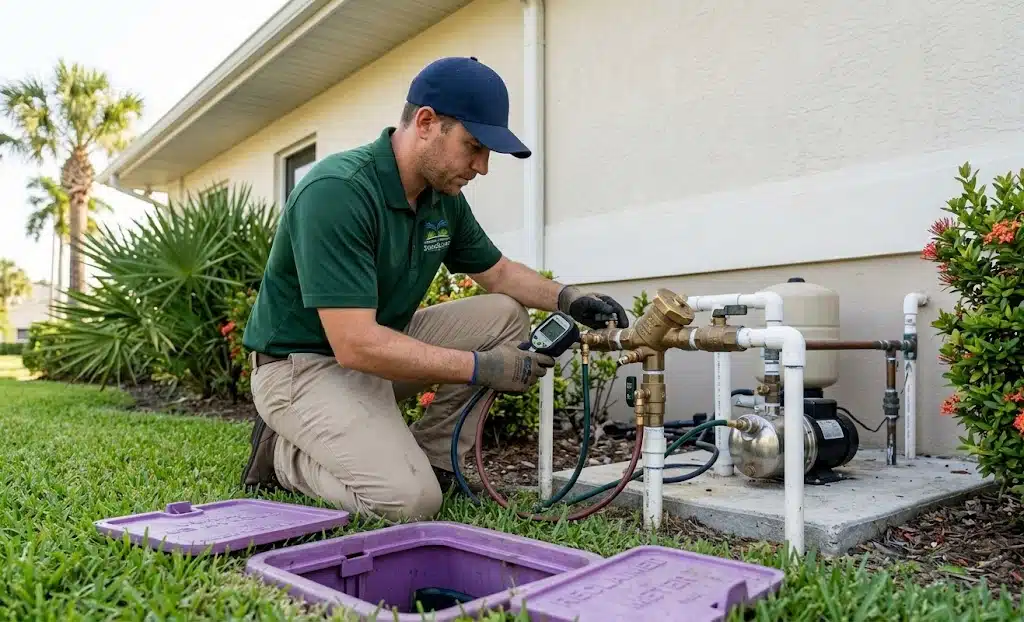
Find the main shutoff valve for the irrigation system — usually in a valve box near the water meter or where the irrigation tees off the house supply — and close it fully. Then close the two shutoff valves on either side of the backflow preventer. No new water should be able to enter the system from this point on.
This is the step that prevents the most expensive repair. Open the small test cocks on the backflow assembly with a flathead screwdriver and let the water drain out. Turn both shutoff valve handles to a 45-degree angle — this lets any trapped water expand without cracking the brass body. In Florida, this one device is responsible for the majority of freeze-damage service calls we see each winter.
Using your chosen method from above: open manual drains, or connect the compressor and blow out one zone at a time. Run each zone until the heads go from spraying water to puffing mist, then move on — about two minutes per zone is typical. Never run the compressor against a closed zone, and never stand directly over a head during blowout.
Wrap the backflow preventer in an insulated cover or purpose-made backflow bag, and foam-insulate any exposed pipe. Above-ground brass and PVC are what the freeze actually attacks — buried lines in Florida’s sandy soil are far less vulnerable.
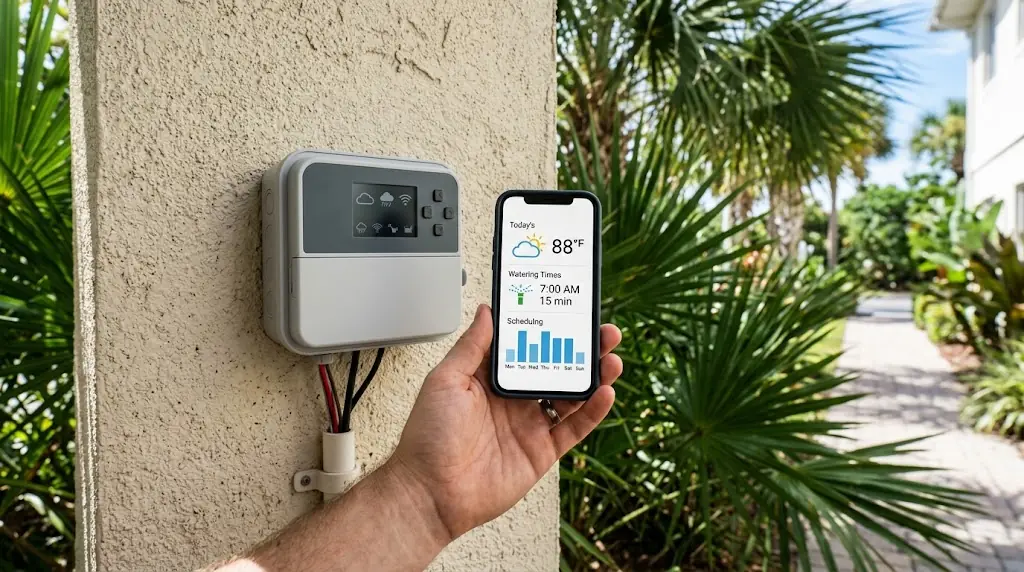
Switch the controller to rain mode or off — don’t just unplug it. Rain mode keeps the programming intact for spring and, on smart controllers, still allows freeze-protection features to function. If your controller has a rain sensor (required by Florida law on systems installed after 1991), confirm it’s active; it’s your backup against a surprise warm-week watering cycle.
If you remember one thing from this guide, make it this: the backflow preventer is what freezes first and costs the most.
Unlike your buried lines, the backflow assembly is a brass device that sits above ground — fully exposed to every freeze. Water trapped inside the brass body expands as it freezes and cracks the casting. We’ve replaced these after single-night freezes in the upper 20s. Typical replacement cost in Northeast Florida: $500 to $1,500+ including parts and labor — the single most expensive freeze repair on a residential system.
Protection is simple and cheap: drain it (Step 2 above), leave the valves at 45 degrees, and cover it with an insulated bag. A $25 cover prevents a $1,000 repair. If your backflow assembly is due for its periodic check anyway, combine it with winterization — learn more about backflow testing requirements in Florida.
Winterizing isn’t just about freeze protection — it’s also about staying legal. The St. Johns River Water Management District governs outdoor watering across Northeast and Central Florida, and the rules tighten in winter:
Set your controller to match when you switch it to rain mode — one less thing to remember in spring. Note that during drought conditions (Northeast Florida saw exceptional drought stress in 2026), the District can tighten restrictions further, so check current rules each fall.
This one comes from citrus agriculture, where growers run micro-sprinklers all night during a freeze — the continuous water releases latent heat as it freezes, protecting buds. Your landscape is not a citrus grove. Running standard spray heads overnight in a freeze coats foliage in ice, snaps branches, and damages ornamentals worse than the cold alone would have. UF/IFAS guidance is clear: don’t do it. Turn the system off and let the plants take their chances — most Florida landscaping recovers from a brief freeze just fine.
January 2025 says otherwise — 20s wind chills in Flagler County, NWS advisories, burst backflow preventers across the county the following week. It only takes one night.
Only if it was built with automatic drain valves — and most Florida residential systems weren’t. If you’ve never seen small drain valves in your valve boxes, assume your system holds water all winter unless you drain or blow it out.
Skipping winterization is a gamble with asymmetric stakes. Here’s the math from our service calls and national data:
Nationally, the Insurance Institute for Business & Home Safety puts the average water-damage claim around $5,000, and burst-pipe incidents in Orlando-area data average roughly $2,500. Worse, Florida’s insurance market has been tightening — some carriers limit or exclude freeze-related water damage, meaning you could pay the whole repair out of pocket. Against that, a professional winterization visit runs $75-$150. It’s the cheapest insurance policy in irrigation. If the freeze already got you, see our sprinkler repair services.
DIY winterization is absolutely doable — if you have (or rent) the right compressor. The non-negotiables: enough CFM to push water (tank size matters less than airflow), a pressure regulator you trust, and the discipline to stay under 50/80 PSI. Where DIY goes wrong: pancake compressors that can’t finish the job, PSI set too high “to be sure,” and forgotten backflow test cocks.
A professional visit takes 15-45 minutes with a commercial compressor, covers the backflow drain, line blowout, insulation check, and controller programming in one trip — and the technician spots failing valves and cracked fittings while they’re in there. For most Northeast Florida homeowners, it’s the sensible default, especially on systems without drain valves.
Either way, pair winterization with an annual system check — our irrigation maintenance visits cover winterization alongside the full inspection.
A single night in the 20s is all it takes to crack a backflow preventer or split a shallow line — and we’ve repaired the aftermath across Flagler County after every recent freeze. Our winterization visit drains, insulates, and programs your system in under an hour, and we check the whole system while we’re there. Schedule your fall winterization before the first advisory hits.
In North and Central Florida — yes. Areas like Palm Coast, Daytona, and Jacksonville see freezing nights most winters (January 2025 brought 20s wind chills to Flagler County). South Florida rarely freezes hard enough to require it, though insulating an exposed backflow preventer is still smart.
Aim for mid-November, before the late-fall cold snaps. A convenient anchor: the first Sunday in November, when clocks fall back and SJRWMD watering drops to one day per week — handle the timer reset and winterization together.
Yes, if your system has manual or automatic drain valves — open them and let gravity empty the lines. If it doesn’t (common in Florida installs), you need a compressor blowout or a pro visit. Small pancake compressors usually lack the airflow (CFM) for a proper blowout.
Stay under 50 PSI for poly pipe and 80 PSI for PVC — never more. Excess pressure cracks fittings instead of drying pipes. Air volume (CFM) matters more than pressure.
No — that’s a citrus-grove technique that backfires on landscape plants. Ice-coated foliage suffers more damage than cold air alone would cause. Turn the system off (UF/IFAS guidance).
Typically $75-$150 for a standard residential system in Northeast Florida, depending on zones and whether the backflow preventer needs attention. Compare that to $500-$1,500+ for a cracked backflow preventer alone.
Yes — the freeze risk is identical. Shut off at the reclaimed meter/valve, drain the system the same way, and check with your provider; some reclaimed systems have their own shutoff procedures.