⭐⭐⭐⭐⭐930+ Happy Customer Reviews
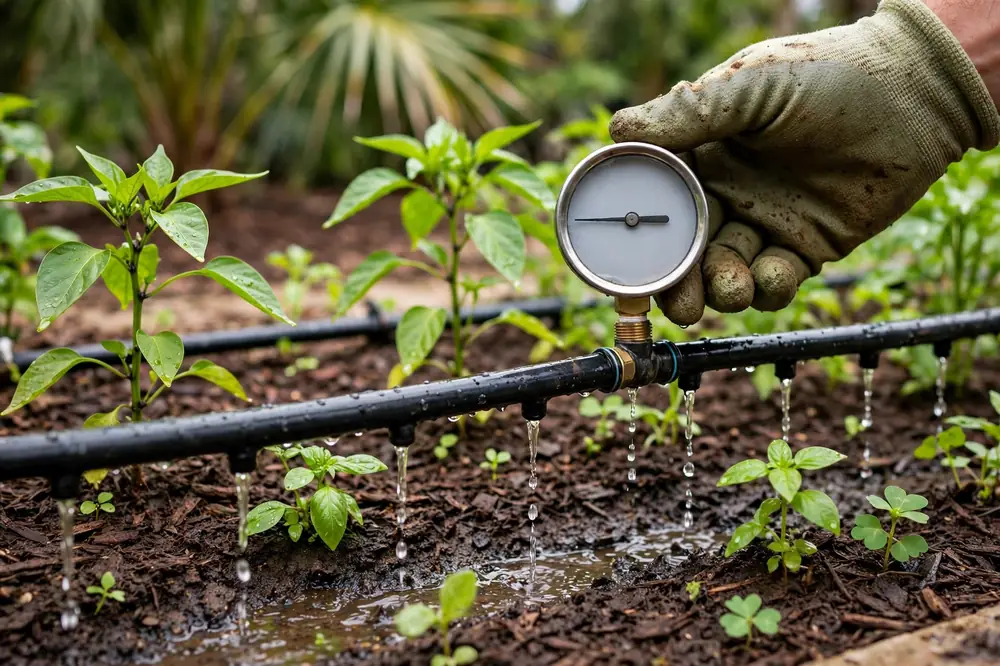
A drip zone fed by house pressure is a small disaster waiting for a hot afternoon. Most homes in Palm Coast deliver 40 to 80 PSI at the tap; most drip emitters are built to work at a fraction of that. Without a reducer, fittings pop, emitters mist instead of dripping, and the plants nearest the supply get soaked while the far end stays dry. This guide is about choosing the right reducer — the preset, the flow rating, and the position in the line — because buying the wrong one, or putting the right one in the wrong place, fixes nothing.
A pressure reducer, or regulator, holds the pressure in a drip zone at a fixed outlet value while water is flowing, even when the supply pressure varies. It does not lower the pressure sitting in a closed line: connect a gauge to a regulator with no water flowing and you will read supply pressure, not the preset. That distinction matters, because it is the single most common reason people declare a new regulator “broken” when it is working exactly as designed. It also cannot fix a clogged filter, a clogged emitter, or a valve that will not close — those faults look similar from the surface, and the diagnostic section below separates them before you spend anything.
Too-high pressure announces itself. Barbed fittings push apart, especially on warm days when tubing softens. Emitters spray a fine mist or a jet instead of steady drops, and the soil right under them erodes into a little crater. Plants nearest the supply look overwatered while plants at the far end look thirsty, because high pressure drives uneven flow along the line. Tubing may bulge at joints or split at a weak bend. If you see two or more of these together on a zone that has no regulator — or a regulator rated far above what the emitters want — pressure is the first suspect, not the emitters themselves.
As typical manufacturer guidance, most poly-tubing drip systems with standard emitters are designed around a 25 PSI regulator, while thin-walled drip tape is usually rated for 10 to 15 PSI — tape is thinner, so it fails sooner under pressure, and a 25 PSI regulator can shorten its life. That is guidance, not a universal rule: always check the rating printed on your emitters or tape before choosing, because a manufacturer rating overrides any number in a guide like this one. If your zone mixes emitter types with different ratings, the lowest rating governs — size for the most fragile part of the zone, not the average.
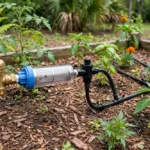
A preset regulator is a sealed unit built to hold one outlet pressure, such as 25 PSI. It has no dial to bump by accident, it costs less, and it suits most residential beds and borders where the emitter type never changes. An adjustable regulator lets you set the outlet pressure with a screw or dial and a gauge, which helps when a zone feeds several emitter types, when you are tuning a large or long zone, or when you need to match a specific manufacturer rating that no preset matches. The trade-off is real: an adjustable unit can be knocked out of adjustment, so it needs a gauge check after any work on the line, and it still needs the same placement and flow-rating checks as a preset.
A regulator is rated not only by outlet pressure but by the flow it can pass without the outlet pressure sagging — usually stated in gallons per minute or gallons per hour. Add up your zone’s peak simultaneous demand: count every emitter on that zone, multiply by each emitter’s rated flow, and convert to the same unit as the regulator rating. A regulator whose flow rating is below that total will starve the far end of the zone whenever everything runs at once, even though its PSI label looks right. As a working rule, pick a regulator whose flow rating comfortably covers your zone’s total at peak — if the numbers are close, go up a size or split the zone, rather than hoping the droop never shows.
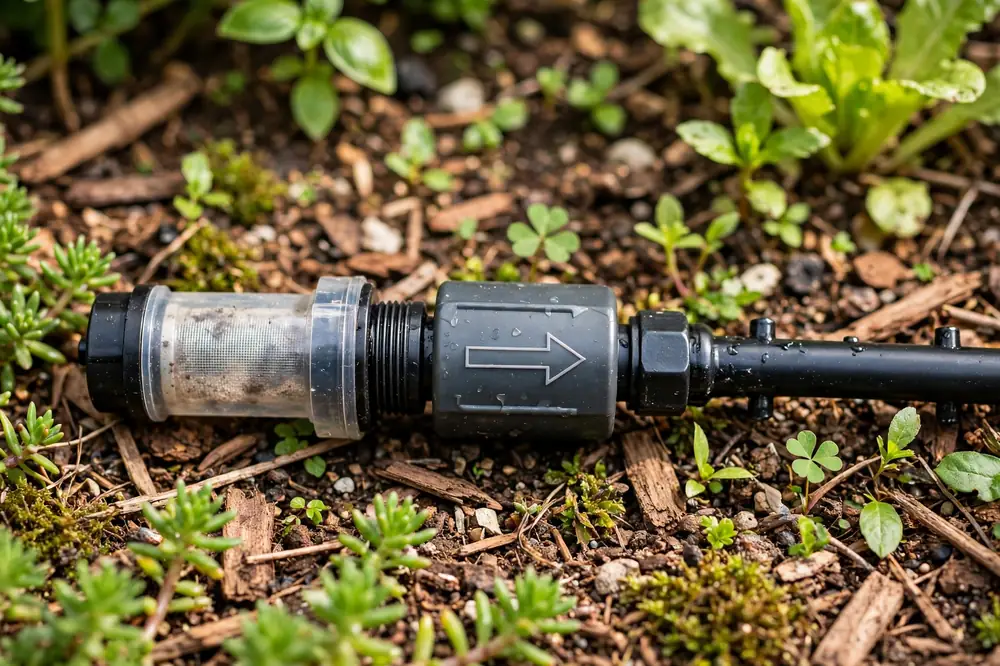
On a hard-piped system the order, from the supply side, is: timer or valve, then backflow preventer, then filter, then pressure regulator, then the drip tubing. The filter before the regulator matters because sediment that reaches the regulator can hold its seat open or clog it; the valve before the regulator matters even more, because most drip regulators are not rated for constant pressure and must not sit pressurised all day. On a hose-bib setup the same logic applies in a compact head assembly: backflow device, filter, then regulator, with the timer or shutoff upstream of them all. Install it with the flow arrow pointing downstream toward the emitters, where you can reach it for inspection — buried where you cannot find it, it will never be maintained. See our drip installation guide for how a full head assembly comes together, and our backflow preventer guide for why that device sits where it does.
Shut the water off and relieve pressure before opening any fitting. Flush the line before the regulator position so grit does not wash straight into it. Check the arrow direction twice — a backwards regulator will not regulate. Use the right thread adapters for your pipe or hose thread, and do not force a mismatched thread, which is how cracked housings happen. Turn the water back on slowly, check every joint for leaks, and leave the zone running for a few minutes before judging anything: a regulator needs flowing water and a filled line before its outlet pressure means anything.
Testing is where most DIY checks go wrong. A gauge screwed onto a closed regulator, or onto the end of a zone that is not running, reads static supply pressure — it tells you nothing about what the emitters see. Put the gauge at the far end of a zone, turn that zone on, let the lines fill and the emitters start flowing, and only then read it: that is your dynamic, working pressure, and it should sit near your regulator’s preset. Test the longest or most heavily loaded zone, not the shortest, and retest after any change to heads, emitters, or zone layout. If the running reading is far above the preset, the regulator is faulty, bypassed, or the wrong type; if it is far below, suspect the filter, the flow rating, or a supply problem — see our low water pressure guide before replacing parts.
High pressure and clogging overlap in one symptom — uneven watering — but they diverge everywhere else. High pressure pops fittings, mists emitters, and soaks the near end while starving the far end. Clogging does the opposite at the emitter: individual emitters slow or stop while their neighbours run normally, and the filter bowl, if you have a clear one, shows debris. A clogged filter starves the whole zone evenly, which can look like low pressure rather than high. Work the cheap checks first: clean the filter, flush the line, and check a few individual emitters before buying a regulator, and test dynamic pressure before condemning the one you have. Replacing a regulator on a clogged zone wastes the part and leaves the clog.
Some pressure problems are not a regulator swap. Call a pro if pressure is low across every zone, not just the drip zone; if a valve will not close and a zone keeps weeping; if you cannot find the irrigation shutoff; if the valve box holds standing water, which points to a valve or fitting fault — see our valve box guide for what that looks like; or if a zone will not run at all. Call sooner if you have already cleaned the filter, checked the regulator position and flow rating, and tested dynamic pressure, and the zone still will not regulate — at that point the fault is usually in the valve, the mainline, or the supply, and digging blind makes it worse.
A regulator is not fit-and-forget. Flush the zone at the start of the watering season and after any mainline work, so sediment does not settle in the seat. Inspect the housing and joints each season for cracks, sun damage, and slow leaks at the threads. If outlet pressure starts drifting, or a zone that used to run evenly goes uneven, clean the filter first, then suspect the regulator: a seat worn by grit or mineral scale will not hold its preset, and no cleaning restores a worn seat. Keep a spare regulator of the same preset and flow rating on hand — it turns a failed zone into a ten-minute swap instead of a week of dry beds.
Installing a drip regulator upstream of the valve or timer, so it sits pressurised all day, is the fastest way to kill it. Most drip regulators are built to regulate while water flows, not to hold back supply pressure around the clock. If your regulator fails early, check its position before blaming the brand.
Matching the regulator’s thread size to your pipe tells you nothing about whether it can pass your zone’s flow. A correctly threaded regulator with too low a flow rating will droop under peak demand and starve the far end. Count emitters, total the flow, and size to that number.
Turning an adjustable regulator up to compensate for a clogged filter, or swapping a preset on a clogged zone, hides the real fault and over-pressures the zone once the filter is eventually cleaned. Clean first, test dynamic pressure second, and only then judge the regulator.
Poly tubing with standard emitters: a 25 PSI preset is the usual starting point, subject to your emitter manufacturer’s rating. Thin-walled drip tape: 10 to 15 PSI, and never higher than the tape’s rating. Mixed emitter types: size to the lowest rating in the zone. Large or long zones, or a rating no preset matches: an adjustable regulator, checked with a gauge at the far end while running. In every case: valve and timer upstream, filter before the regulator, flow rating above peak demand, and a dynamic-pressure test before you call the job done.
If a new, correctly sized, correctly placed regulator changes nothing, the fault was never pressure. Re-test dynamic pressure at the far end while running; if it now matches the preset but watering is still uneven, the problem is distribution — emitter spacing, a kinked lateral, or a zone carrying more area than it was designed for. If dynamic pressure still will not hold, the fault is upstream: supply, valve, or mainline. Either way, stop swapping regulators — our components guide maps how each part of the system affects the rest, and it is a better next step than a second identical part.
We inspect drip and sprinkler systems across Palm Coast and Flagler County every week — head assemblies, pressure, flow, and zone-by-zone tuning for garden beds and St. Augustine lawns.
Call (386) 237-2983 for an irrigation inspection: we will test dynamic pressure at the far end of your zones, check the regulator position and flow rating, and tell you whether the fix is a regulator, a filter, or a valve — before you spend on anything else.
Almost always, yes. Most homes deliver 40 to 80 PSI, while most drip emitters are designed for a fraction of that. Without a reducer, fittings pop, emitters mist instead of dripping, and watering turns uneven. The exception is a supply that already sits at or below your emitters’ rated pressure — verify that with a running-zone test, not by guessing.
As typical manufacturer guidance, 25 PSI suits most poly-tubing systems with standard emitters, and 10 to 15 PSI suits thin-walled drip tape. Always check the rating on your own emitters or tape first, because a manufacturer rating overrides any general number, and if a zone mixes types, the lowest rating in the zone governs.
Downstream of the valve or timer, and downstream of the backflow preventer and filter, with the flow arrow pointing toward the emitters. It must not sit under constant pressure all day, and it should be somewhere you can reach for inspection. On a hose-bib setup, the same order applies in the head assembly: backflow device, filter, then regulator.
Preset suits most residential beds: one fixed outlet pressure, nothing to knock out of adjustment, and lower cost. Adjustable suits zones with mixed emitter types, large or long zones, or a manufacturer rating no preset matches — but it needs a gauge check after any work on the line, because it can drift out of adjustment.
Because the zone was not running. A regulator only regulates while water flows; with no flow, a gauge reads static supply pressure, which tells you nothing about what the emitters see. Test at the far end of a running zone, after the lines have filled and emitters are flowing — that dynamic reading is the one that matters.
Check the pattern. Popping fittings, misting emitters, and a soaked near end with a dry far end point to pressure. Individual emitters slowing while neighbours run normally point to emitter clogs; a whole zone starving evenly points to a clogged filter or low supply. Clean the filter, flush the line, and test dynamic pressure before replacing any part.