⭐⭐⭐⭐⭐930+ Happy Customer Reviews

To fix low water pressure in a sprinkler system, start with the easy stuff. Open the main and backflow valves all the way, clean out clogged nozzles and filter screens, and walk the yard for leaks. Then put a gauge on it. One weak zone means the trouble is in that zone. Every zone weak? Look at the supply.
Weak spray is frustrating. You pay for water, the timer runs, and half the lawn still turns brown. Here in Palm Coast, Bunnell, Ormond Beach and the towns around them, we see it all the time, and the cause is usually simpler than people fear.
This guide covers what good pressure looks like, how to read the clues your system gives you, a ten-minute gauge test, and a fix for every common cause. We also get into the Florida-specific stuff most guides skip: sandy wells, iron, and reclaimed water.
Most home systems want somewhere between 30 and 50 PSI (pounds per square inch) at the head. That’s the short answer. The longer answer is that each head type has its own comfort zone, and running outside it causes problems either way. Too little pressure, and the water falls short. Too much, and you get a fine mist that drifts off with the breeze.
| Head Type | Works Best Around | What Low Pressure Looks Like |
|---|---|---|
| Spray heads | About 30 PSI | Short, droopy spray that falls short of the next head |
| Rotor heads | 40 to 50 PSI | Rotors turn slowly, stall or throw a short stream |
| Rotary (multi-stream) nozzles | About 40 PSI | Thin streams that barely reach half their radius |
| Drip irrigation | 15 to 30 PSI | Emitters farthest from the valve barely drip |
Treat these as ballpark numbers. Your head manufacturer publishes a chart for each model, and it’s worth a quick look.
You can spot most pressure problems before you ever buy a gauge. Turn on a zone, stand back, and give it a full minute. Watch for:
Don’t start buying parts yet. The way the problem shows up tells you a lot. Most cases fall into one of four groups.
Good news. If the other zones are strong, your water supply is fine, and the problem lives somewhere between that zone’s valve and its heads. Usual suspects: a cracked pipe, a dirty or worn valve diaphragm, a flow control knob that got turned down, plugged nozzles, or simply a zone carrying more heads than it can feed.
Now you’re looking upstream. Think main shut-off, backflow preventer, pressure regulator (if your system has one), the water meter, and the pump if a well feeds the system. A leak in the main line counts too. That’s the pipe that holds pressure 24/7, so a break there steals from every zone at once.
This pattern almost always means demand is outrunning supply. On city water, the zone is probably asking for more gallons than your line can push. On a well, suspect the pump, a pressure tank that’s lost its air cushion, or a well that’s started pulling sand.
Plenty of homes in Bunnell, rural Flagler County and parts of Palm Coast water the lawn using a private well. When the house has great pressure but the sprinklers on the well are weak, go straight to the pump side: the pressure switch, the tank, and the intake screen. Well water also carries sand and iron, which plug nozzles much sooner than city water does. Our pump service page walks through the usual repairs.
| Symptom | Most Likely Cause | First Thing to Try |
|---|---|---|
| One zone weak, others fine | Leak, clogged nozzles, valve problem or an overloaded zone | Run the zone and look for wet spots or bubbling |
| All zones weak | Partly closed main or backflow valve, regulator, main line leak or low supply | Make sure every supply valve is fully open |
| Strong at first, then fades | Zone demands more water than the supply can give, or a pump problem | Count the heads on the zone and check the pump |
| Only certain heads are weak | Clogged nozzle or filter screen | Remove and rinse the nozzle and screen |
| Weak on a well, fine on city water | Pump, pressure switch, pressure tank or well screen | Watch the pressure gauge at the tank while the zone runs |
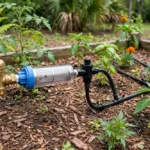
Guessing gets expensive. A basic hose-thread pressure gauge costs very little at any hardware store, and the whole test takes about ten minutes.
Tip: snap a phone photo of the gauge for each zone. It makes comparing them later much easier.
Static pressure is what sits in the pipe when nothing is flowing. Working pressure is what’s left once water starts moving. The working number will always be lower, because pipes, fittings and valves all eat a little pressure. A modest drop is normal. A big drop on one zone usually means that zone wants more water than the pipe can deliver, or that water is escaping somewhere.
Keep in mind that a hose bib only shows you what’s coming into the property. By the time water reaches a sprinkler head, the backflow preventer, valves and pipe have all taken their cut. Want the real number at a head? Swap the nozzle for a gauge with a riser adapter, or hold a pitot gauge in a rotor’s stream.
Check this first. Seriously. It’s free, it takes two minutes, and it’s behind more weak systems than you’d think. A valve gets half-closed during an old repair, or a mower clips the handle, and suddenly every zone runs at half strength.
Find the shut-off for the irrigation line, plus the two shut-off valves on the backflow preventer. Ball valves are open when the handle runs parallel to the pipe. Open them all the way and run a zone again. If the backflow device itself is leaking or stuck, that’s a job for a licensed tester, which we cover on our {L(‘/irrigation-backflow-testing/’, ‘backflow testing service’)} page.
Under most spray nozzles sits a tiny filter screen. Over time it fills with sand, bits of grass and mineral flakes, and the spray gets weaker and weaker.
The fix is easy. Unscrew the nozzle, pull the screen, and rinse both under the hose. For stuck grit, use a toothpick or an old toothbrush. Don’t poke at the opening with a nail or knife; one scratch and the spray pattern is ruined. If a nozzle won’t come clean, toss it. When a whole zone of heads is worn out, our sprinkler head service can replace them in a single visit.
Northeast Florida wells are known for two things: fine sand and dissolved iron. Sand grinds and plugs nozzles. Iron leaves orange crust inside the heads and those familiar rust stains on walls and sidewalks.
If your house has orange streaks on it, expect clogs more often than your neighbors on city water. A filter after the pump, a regular line flush, and nozzles made to tolerate grit all help. And if a well suddenly starts spitting sand, have a well professional look at the screen before it gets worse.
Water that leaks out underground never makes it to the heads. Look for spots that stay soggy, a strip of grass greener than everything around it, a small sinkhole, or water bubbling up while a zone runs.
Your water meter is a handy detective here. Shut off all water in the house and watch the dial. If it’s still moving, you’ve got a leak somewhere. Our {L(‘/sprinkler-system-leak-detection/’, ‘sprinkler leak detection guide’)} has more ways to track one down.
One rule before you dig: call 811. Sunshine 811 is free, and it gets buried gas, power and water lines marked so you don’t hit one. Give them at least two full business days.
Inside every zone valve is a rubber diaphragm that opens and closes the flow. A bit of debris stuck under it, or a small tear, keeps it from opening all the way.
Also look for a flow control knob on top of the valve. If someone dialed it down, that zone will always run weak, no matter what else you fix. Turn it counterclockwise until it stops. Still weak after that? The valve probably needs a cleaning or a new diaphragm.
Every head uses a set amount of water, measured in gallons per minute (GPM). Add up all the heads on a zone. If that total is more than your supply can give, all of those heads suffer. This happens a lot when heads get added over the years without anyone checking the math.
Here’s a quick way to check. Time how long it takes to fill a 5-gallon bucket from an outdoor faucet. Divide 300 by those seconds, and you’ve got your available GPM. Say the bucket fills in 30 seconds: that’s about 10 GPM. Now total up the GPM for the nozzles on the zone (the nozzle chart lists it). If the zone wants more than you have, it needs fewer heads or lower-flow nozzles.
Some systems use a pressure regulator, usually near the backflow preventer or built into the valves. Set too low, or worn out, it chokes the whole system. On adjustable models, check the setting and test pressure before and after the regulator if you can. If it’s failed, replace it. Don’t just pull it out, because it’s there to protect your heads and pipes.
On a well, the pressure switch decides when the pump kicks on and shuts off. You’ll often see settings like 30/50 or 40/60 PSI: the pump starts at the low number and stops at the high one. If the switch is set too low, or its contacts are burnt, the system never builds full pressure.
Hear the pump clicking on and off every few seconds? That’s called short cycling, and it usually points to a waterlogged pressure tank. Since pump work involves electricity, leave this one to a pro. Our {L(‘/well-pump-repair/’, ‘well pump repair team’)} handles it.
Sometimes it isn’t your system at all. When half the neighborhood waters on the same assigned day, street pressure can sag. Older or undersized supply pipe can also limit flow. Try the gauge test at a different hour. If the static number stays low, call your water utility before you change anything on your end.
Fix the cause, and most systems bounce right back. If yours still struggles because the supply is simply too small, these upgrades make a real difference.
Moving a few heads onto a new zone is often the single best fix. Each zone asks for less water, so every head gets more pressure. You’ll need a new valve, some pipe, and an open station on your controller.
Rotary nozzles, the kind that throw several thin streams, cover the same ground as a standard spray nozzle with less water. That lets more heads share the same supply. They also lay water down slowly, which sandy Florida soil soaks up better.
Small pipe over a long run loses a lot of pressure. Swapping an undersized section or a restrictive valve for a bigger one cuts that loss. It’s a bigger project, though, so it usually makes sense only when you’re already repairing or redesigning that zone.
A booster pump raises pressure from a weak supply. It works when pressure is low but there’s still enough water volume. It won’t fix leaks, clogs or overloaded zones, so rule those out first. It also needs proper wiring and backflow protection. Not sure if you need one? Our pump specialists can tell you.
A lot of homeowners think they have to wait for their watering day to test a repair. You don’t. The SJRWMD, which manages water use in Flagler County, Volusia County and St. Johns County, makes room for maintenance and repair work. You can turn a zone on any day of the week to check your fix, as long as it stays on for 20 minutes or less each hour. That’s plenty of time to check spray patterns and take a gauge reading. Our irrigation maintenance service keeps your timer set right for whatever schedule is in force.
Parts of Port Orange and a few other neighborhoods irrigate with reclaimed water. It’s a smart way to save drinking water, but it holds more nutrients and fine particles than city water does. Over time, algae grows in the filters and the nozzle openings narrow. If you’re on reclaimed water, clean your screens more often and pick nozzles built to resist clogging. Reclaimed systems also run on their own watering schedule, so check with your utility for the days and hours.
| Problem | DIY Friendly? | Call a Pro When |
|---|---|---|
| Valve not fully open | Yes | The backflow preventer leaks or will not open |
| Clogged nozzle or screen | Yes | Clogs return within weeks, which points to a water source problem |
| Zone valve flow control | Yes | The diaphragm is torn or the valve will not open |
| Small leak at a head | Often | The leak is under pavement or on the main line |
| Overloaded zone | Sometimes | The zone needs a new valve and new wiring |
| Pressure regulator | Sometimes | You are not sure of the correct setting |
| Well pump or pressure switch | No | Always, because the job involves electrical work |
| Booster pump | No | Always, for safe wiring and backflow protection |
Checked the basics and still stuck? Our sprinkler repair technicians can track it down fast. And if you’d like a price idea first, our sprinkler repair cost guide shows what common repairs usually run in Northeast Florida.
If low water pressure keeps coming back after these checks, let us take a look. We’re irrigation specialists serving St. Augustine, Palm Coast, Bunnell, Flagler Beach, Ormond Beach, Daytona Beach and Port Orange. Request a service visit, or speak with a technician at (386) 237-2983.
Open every supply valve fully first, since a half-closed valve is the most common culprit. Next, clear the nozzles and screens. Then run each zone and look for leaks. Still weak? A pressure gauge will tell you whether the issue sits in one zone or in the supply.
Because the problem is almost always inside that zone. Check its pipe for a leak, its valve for a dirty or torn diaphragm, and the flow control knob on top. Plugged nozzles and too many heads are the other two big ones.
Aim for roughly 30 to 50 PSI at the heads. Sprays like about 30, rotors like 40 to 50, and drip zones run happily on 15 to 30.
It can. If either shut-off handle on the device is only partly open, or the parts inside are worn, flow to the whole system drops. Make sure both handles line up with the pipe. A faulty device should be repaired by a licensed tester.
Only in one situation: your incoming pressure is low but you have enough water volume. A booster won’t cure leaks, clogs or overloaded zones, so sort those out before spending money on a pump.
Usually the zone is asking for more water than the supply can keep up with. On a well, a waterlogged tank, a tired pump or a low pressure switch setting can cause the same fade.
It is. You can switch a zone on whenever you need to check a repair. The water district only asks that each zone stay under a twenty-minute limit per hour.
Twice a year is the minimum. On well or reclaimed water, check them every few months, because sand, iron and algae build up fast.