⭐⭐⭐⭐⭐930+ Happy Customer Reviews
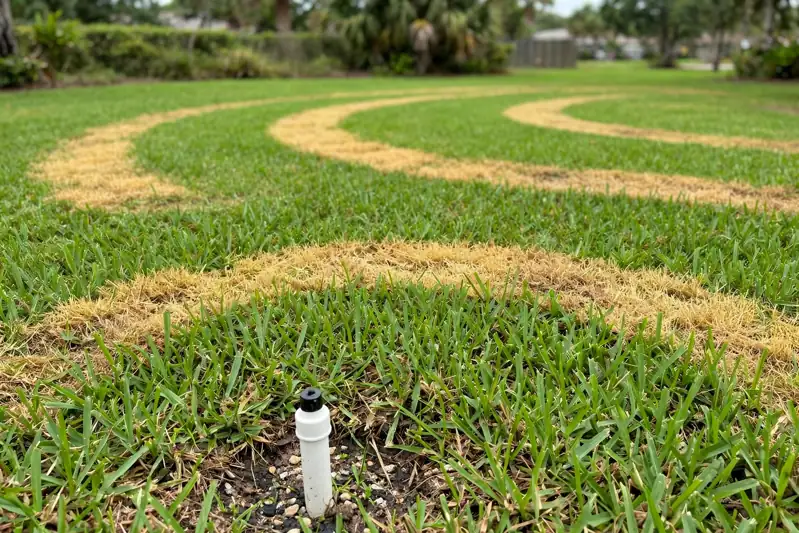
Yellow grass is a symptom, not a diagnosis — and the shape of the yellow tells you more than the colour does. On a St. Augustine lawn in Palm Coast, the same pale patch can mean four completely different sprinkler problems, each with a different fix. Watering more fixes only one of them; the other three get worse with more water. Before changing a single setting, read the pattern: whole lawn fading, arcs and wedges, one yellow zone, or soggy ground under the yellow? This guide walks through each pattern, then a one-run system check, so you fix the cause instead of guessing at the schedule.
Homeowners usually start with a bag of something — fertilizer, fungicide, iron — and hope the yellow goes away. That is backwards for an irrigation problem, because a sprinkler fault leaves a signature in the shape of the damage. A whole lawn fading evenly points to how much water the whole system delivers, or how often. Arcs, wedges, and stripes point to individual heads and coverage. One yellow zone beside green zones points to that zone alone: its valve, its pressure, or its run time. Soggy ground under yellow grass points to too much water, not too little. Work out which of the four patterns you have first, and the rest of this guide narrows to a short list of checks instead of a long list of guesses.
When the entire lawn loses colour together — no sharp edges, no single bad patch, just a general pale tint — the cause is usually system-wide, not one head. The most common version is shallow, frequent watering: short daily runs that wet only the top inch of soil, so roots stay shallow and stress between runs. A second version is a schedule that never changed with the season. A third is a controller problem — a rain sensor stuck on, a program turned off, or a seasonal-adjust setting left low. Check the controller first: program on, start times as expected, no zone at a fraction of its run. Then check the soil: a screwdriver stopping after an inch in dry soil means no deep water; sliding easily into wet soil means drought is not the problem — skip to Pattern 4.
Arcs and wedges are the clearest sprinkler signature there is: grass only turns yellow where water does not reach. A clogged, tilted, or sunk head throws a short, uneven arc, and the dry wedge beyond it yellows first. A head blocked by a shrub or fence leaves a shadow-shaped dry patch. A head that no longer pops up fully sprays into the grass around it, and the area just past it dries out. Walk the zone while it runs: heads that sputter, spray a fan instead of a clean arc, or sit buried under mulch, and spray that hits a hard surface and runs off. Two adjacent heads should overlap by roughly a third — if you can stand between two heads and stay dry, that strip gets almost nothing. No schedule change fixes this: the head, nozzle, or position has to change.
One bad zone beside healthy zones rules out weather, fertilizer, and the whole-system schedule at a glance — those would affect every zone. The fault lives in that zone. Start with run time: a zone set much shorter than its neighbours, or skipped by a program, starves only that area. Next, pressure: a partially closed valve, kinked lateral, or too many heads for the supply throws short arcs, and our low water pressure guide walks through the pressure checks. Next, coverage: does that zone cover a slope, sunny strip, or sandy patch needing more water than shady zones beside it? If heads and pressure look right, check whether this zone is carrying an area it was never designed to cover — see our guide to how many irrigation zones a yard needs.
Yellow grass on wet, spongy ground is overwatering, and more water is the worst response. Roots need air as well as water: saturated soil starves roots of oxygen, and grass yellows and thins despite plentiful water. Usual causes: a zone running too long or too often, a valve that does not fully close and keeps a zone weeping, or a low area where water collects. Press the ground: water pooling around your shoe, or soil still wet a full day after the system ran, means overwatering. Check shutoff too — heads still dribbling after the controller stops that zone point to a valve problem, not a schedule problem. If ground stays soggy long after the system is off, the zone-by-zone logic in our drain guide helps separate a system holding water from a yard that cannot shed it.
Once you have a pattern, confirm it with one zone run. You need a screwdriver, a few empty tuna cans or straight-sided cups, and a notebook. Run one zone at a time, in daylight, where you can see every head, and adjust nothing during this run — you are collecting evidence, not fixing yet. Note per zone: which heads pop up fully and throw a clean arc, where spray actually lands, and where ground is dry, wet, or soggy afterwards. That page of notes usually names the cause, and it is what a technician will ask for if you call one.

Start the zone and watch it from start to finish. A healthy head pops up promptly, throws a steady arc, and stops cleanly when the zone shuts off. The faults to note are specific: a head that stays down or only half rises, a head that sputters or mists instead of spraying, a head tilted so its arc lands on a path or a bed, and a head that keeps dribbling minutes after shutoff. A head that will not pop up at all is a common cause of a dry wedge right beside it, and our sprinkler head won’t pop up guide covers the causes in order. Mark every faulty head with a flag or a stick as you go — by the time the zone finishes, you will forget which one sputtered.
Eyes lie about water; cans do not. Place straight-sided cans across the zone — near heads, midway between heads, and at the far edge — and run it for a fixed 15 minutes as a test. Even depth means even coverage. Cans full near a head and nearly empty between heads mean a spacing or arc problem, not a schedule problem. All cans shallow mean under-delivery: run time, pressure, or valve. Deep in one area and shallow in another means adjust heads, not minutes. As typical guidance only, established St. Augustine lawns here do best with deep, infrequent watering that soaks several inches down, not short daily sprinkles — but set the actual run time from your can measurements, not a national chart, because soil, shade, and slope change the answer yard by yard.
The valve box is where zone problems hide. Open it and look before you touch anything: standing water, mud, or a box that smells damp days after the system ran all point to a valve or fitting issue in that box. A box full of water is a symptom worth reading properly before you bail it out — see our valve box full of water guide for what each cause looks like. Check the wiring for loose or corroded connections, which can leave a zone running short or not at all, and check that each valve closes fully when its zone ends. Do not force a stuck valve or fitting: a valve that will not close is a repair, and forcing it can turn a zone problem into a mainline problem.
Fix in this order, each step cheaper and more certain than the next. First, heads: clean clogged nozzles, straighten tilted heads, raise sunk heads to grade, and replace cracked ones. Second, coverage: adjust arcs so neighbouring heads overlap, and move or add a head only if a gap cannot be closed by adjustment. Third, schedule: set run times from your can measurements, zone by zone, instead of raising every zone by the same amount. Fourth, zone pressure and valves: only after heads and schedule are right does it make sense to chase pressure or replace a valve. Skipping straight to step four is how homeowners replace a valve and still have the same yellow wedge, because the wedge was a tilted head all along.
Some yellow-grass causes are not homeowner fixes, and knowing the line saves both the lawn and the system. Call a pro if a zone will not run at all, if the pressure is low across every zone, if a valve will not close and a zone keeps weeping, if you cannot find the irrigation shutoff, or if the ground stays soggy days after the system is off and you suspect a mainline leak. Call sooner rather than later if the yellow is spreading fast, if large patches are already straw-coloured and brittle, or if you have already adjusted heads and schedule and nothing changed — at that point the fault is usually underground, and digging blind makes it worse.

The instinct with yellow grass is to water more, and for Pattern 4 it is exactly wrong: soggy roots yellow faster with more water. Even for dry patterns, adding a daily short run on top of the existing schedule usually makes shallow roots shallower. Diagnose the pattern first, then change one thing — heads, coverage, or run time — and give it a week before changing anything else.
Raising every zone by the same amount fixes nothing when only one zone is at fault, and it over-waters every healthy zone in the process. Zone run times should differ: sunny, sloped, and sandy areas need more than shaded, flat ones. Set each zone from its own can measurements, not from a single yard-wide number.
A new head in the same wrong position throws the same wrong arc. Before buying anything, check whether the existing head is clogged, tilted, sunk, or blocked — four free fixes that account for most arc and wedge problems. Replace a head only when it is cracked, its seal is gone, or adjustment cannot close the gap.
Whole lawn pale and even: schedule, run time, or controller setting — check the program, then the soil depth. Arcs, wedges, or stripes: individual heads — clogged, tilted, sunk, or blocked. One zone yellow, rest green: that zone’s run time, pressure, valve, or coverage — check it alone. Soggy ground under yellow grass: overwatering or a valve that will not close — check shutoff first, then drainage. Yellow that does not fit any of these, or yellow with spots, rings, or insects visible, is the one case where the cause is probably not irrigation at all — see the rule-outs below.
Not every yellow lawn is a sprinkler problem. A lawn short on nitrogen fades evenly, like Pattern 1, but the soil is moist and the system checks out — a lawn-care question, not an irrigation one. Fungal problems often show as rings or patches with distinct edges and blade spots after wet, humid spells. Insect damage tends to lift easily or thin from the roots up. Dog spots are small, round, and scattered, not sprinkler-shaped. Mower scalping leaves a uniform cut line. None of these are diagnosed here: if one fits better than any irrigation pattern, or grass is already dead and brittle over a large area, get a lawn assessment first — fixing the wrong system twice costs more than one correct diagnosis.
We inspect irrigation systems across Palm Coast and Flagler County every week — coverage, pressure, and valve checks, plus zone-by-zone run-time tuning for St. Augustine lawns.
Call (386) 237-2983 for a sprinkler inspection: we will run every zone, measure what each one actually delivers, and tell you whether the fix is a head, a valve, or a schedule — before you spend on anything else.
Because the cause is local, not yard-wide. Arcs and wedges mean a head or coverage gap in that spot. One yellow zone beside green zones means that zone’s run time, pressure, or valve. Whole-lawn fading is the only pattern that points to the overall schedule. Match the shape first — it narrows the cause to a short list before you change anything.
Yes — running every day is not the same as watering well. Short daily runs wet only the top inch of soil, so roots stay shallow and the grass stresses between runs. Clogged or tilted heads can also leave dry wedges even while the system runs on schedule. Check coverage and soil depth, not just whether the controller is on.
Press the ground and check the soil. Dry, hard soil an inch down with a screwdriver that stops short means underwatering or shallow watering. Spongy ground, water pooling around your shoe, or soil still wet a full day after the system ran means overwatering. Yellow on dry ground and yellow on soggy ground are opposite problems with opposite fixes — the soil test tells them apart.
That zone alone is at fault. Check its run time first, then its pressure and valve, then its coverage — a zone with too many heads, a partially closed valve, or a slope it was never designed for will under-deliver while neighbouring zones do fine. The rest of the system is evidence, not the problem: healthy zones rule out weather, fertilizer, and the whole-system schedule.
Not until you know the pattern. Watering more helps only a genuinely dry lawn. On soggy ground it makes root suffocation worse, and on a coverage gap it waters the green areas while the dry wedge stays dry. Diagnose first — pattern, then one zone run, then one fix — and give that fix a week before changing anything else.
Call if a zone will not run at all, pressure is low across every zone, a valve will not close and a zone keeps weeping, you cannot find the shutoff, or the ground stays soggy days after the system is off. Also call if you have adjusted heads and schedule and nothing changed — at that point the fault is usually underground, and digging blind makes it worse.