⭐⭐⭐⭐⭐930+ Happy Customer Reviews
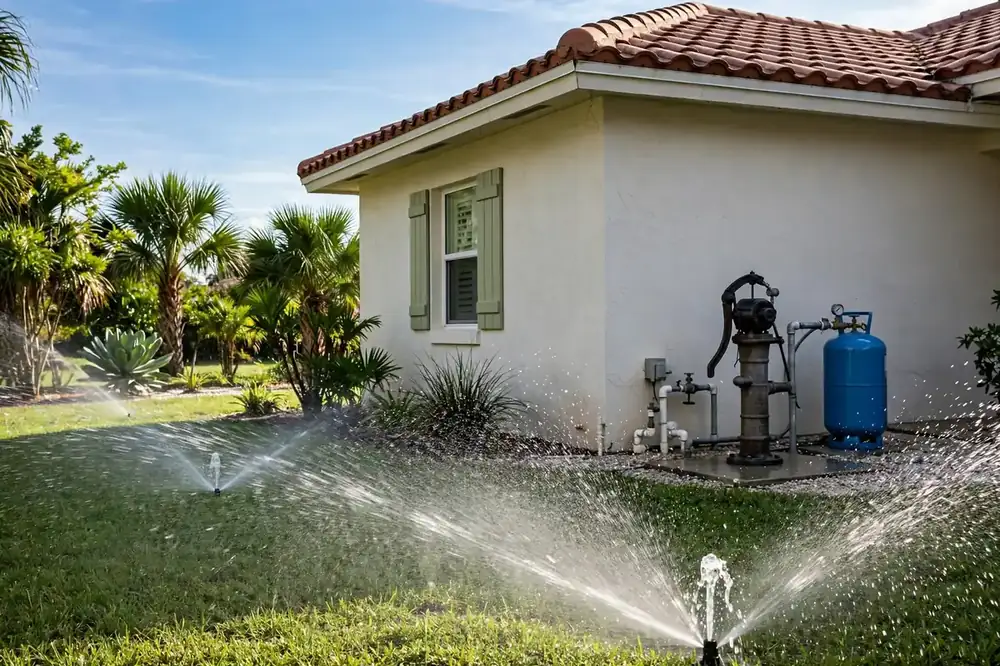
A private irrigation well removes the monthly water cost of lawn watering, but adds drilling, a pump to maintain and, often, iron staining. City water is simpler and cleaner but billed every month. In Palm Coast, wells still follow the current watering schedule, and where reclaimed water is available, a new irrigation well is not allowed.
Key takeaways:
Most Palm Coast lawns run on one of three water sources, and the right choice depends on your lot, your bill and your water. Reclaimed water gets one column here only; its full rules and sprinkler care belong to our reclaimed water guide.
| City water | Private well | Reclaimed water | |
|---|---|---|---|
| Upfront cost | Lowest — meter and hookup already in place | Highest — drilling $3,000-$7,000 plus pump and hookup | Low if already connected; connection cost varies |
| Monthly cost | Billed per gallon; about $90 a month at 10,000 gallons on an irrigation meter | Electricity and upkeep only; no water bill for the lawn | Billed separately by the utility; rates vary |
| Pressure | Steady, set by the utility | Set by your pump; output limits zone size | Utility pressure; sediment raises filter work |
| Water quality | Treated, consistent | Iron, sulfur and sand are common in shallow wells | Treated wastewater for irrigation; sediment and algae common |
| Staining | Rare | Orange iron stains on walls, drives and decks | Possible where sediment and minerals settle |
| Maintenance | Least — mainly heads, valves and controller | Most — pump, tank or relay, filter and check valve | More filter cleaning and head flushing than city water |
| Watering rules | Current watering schedule applies | Same current schedule applies, including the Phase III no-watering window of 8 a.m. to 6 p.m. | Separate schedule; retail reclaimed meter customers are not bound by the Phase III schedule |
Read the rest with your own numbers in hand: last summer’s bills and your lawn size.
A well-fed system starts at the well: a pump lifts water and pushes it into the irrigation main, and the controller opens zone valves in turn just as on city water. The difference is everything between the well and the first valve. On city water the utility holds the pressure; on a well your own equipment must hold it, which is why pump choice, tank or relay setup, and filtration matter. Our well pump repair guide owns pump types and repairs in detail.
The working parts are a pump, a pressure tank or a pump start relay, a filter, a check valve, and the electrical supply. A tank setup stores water under pressure so the pump cycles as zones draw; a relay setup skips the tank and runs the pump whenever the controller calls for a zone. The filter catches sand before it reaches valves and nozzles, and the check valve stops water flowing back into the well. If controller, relay and pressure switch are not wired to work together, zones run weak or the pump short-cycles. See our pressure switch guide.
Start with the two numbers people get wrong. Drilling a shallow irrigation well in Florida often costs $3,000-$7,000, and that buys the hole and casing, not the finished system: pump, tank or relay, filter, wiring and hookup sit on top. A fitted pump replacement runs $600-$1,400, and pumps last roughly 8-15 years, with iron and sand shortening that life. A well is not a one-time purchase; any payback calculation that ignores the second pump is optimistic. Our pump lifespan guide covers failure signs.
City water is almost all running cost. On a Palm Coast irrigation meter the base fee is $12.94, then $7.72 per 1,000 gallons up to 10,000 gallons, $9.84 up to 20,000, and $12.63 above that. At 10,000 gallons a month that is about $90 a month, roughly $1,080 a year for lawn water. A large lawn watering heavily through summer passes that figure easily, which is where a well starts to pay back; a small lot on a modest schedule may never reach the point where drilling pays for itself. See our sprinkler system cost guide.
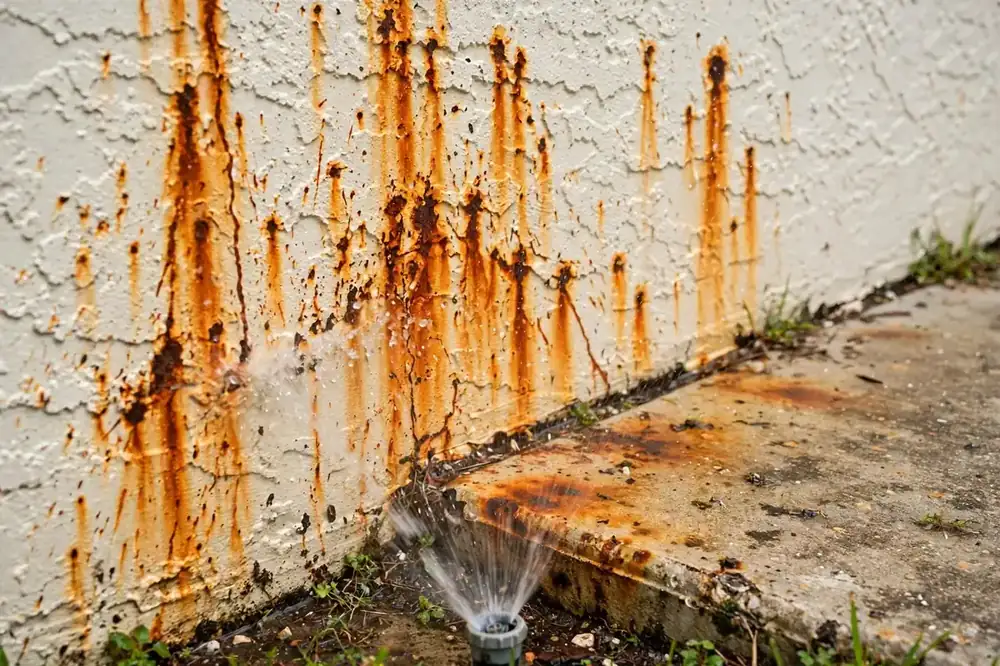
Shallow Palm Coast wells commonly carry iron and sulfur, and the first sign is rarely the water itself — it is the orange streak down a stucco wall, driveway or pool deck where a head sprays the same surface every cycle. Iron oxidises as it dries, so a head that overshoots the lawn by even a foot paints a stain that darkens with every watering. Sulfur shows up as a rotten-egg smell and corrodes fittings faster than clean water. Neither makes a well unusable, but both mean the system must be designed around the water.
Three fixes handle most staining. First, aim heads so spray never lands on walls, fences, pool decks or cars — the cheapest fix, and the one most often skipped. Second, fit filtration sized to the water: a sediment filter for sand, an iron filter where tests show iron high enough to stain. Third, where staining persists, a sequestering system keeps iron dissolved so it passes through heads without settling. Test the water before buying any of it, and no filter removes the need to aim heads properly.
City pressure arrives fixed and stays there; well pressure is whatever your pump delivers, and it falls as more heads run at once. That sets zone size. A well that feeds six heads comfortably may leave ten weak at the far end, misting near the pump and dry at the edge. The fix is smaller zones and more of them, costing more in valves, wire and controller stations — a real part of the well price rarely in drilling quotes. Large zones built for city pressure may need splitting on conversion.
Before you commit, get the well’s output measured in gallons per minute and match zones to it, not to the lawn’s shape. Our zones guide explains how zone count follows head demand and supply.
If heads already spray weak, our low pressure guide checks filters, leaks, valves and pump output in order. A well that cannot hold pressure across a zone is no bargain.
In Flagler County, DOH-Flagler issues construction permits and inspects wells under 6 inches in diameter, for drinking-water and irrigation wells alike. That permit comes before drilling, not after. A driller who suggests skipping it is telling you how they work, not how the rules work.
Two rules surprise homeowners most. First, wells still follow the current watering schedule, including the Phase III no-watering window of 8 a.m. to 6 p.m. — a well buys no exemption, and the schedule lives on our Palm Coast watering days page rather than in this guide, so it stays current when the order changes. Second, where reclaimed water is available, a new private irrigation well is not authorised at all. Check reclaimed availability before paying for a drilling quote. The district does not regulate private well users through consumptive use permits, so do not let anyone sell you one.
A well makes sense when three things line up: a large lawn that drinks heavily through summer, city bills high enough that payback lands inside one pump’s life, and water clean enough that staining and filter costs stay modest. It also makes sense where city pressure is poor and a dedicated pump would fix coverage anyway — then the well solves two problems at once.
A well does not make sense on a small lot with a modest schedule, where the annual saving may never repay drilling plus a pump replacement. It does not make sense where reclaimed water is available, since a new well is not authorised there. And it is a poor fit where iron is heavy or the source already struggles in dry years. Run the numbers with your actual bills and a water test, not a neighbour’s story — wells vary street to street, and so does the payback.
Switching is a hookup job, not just a pump job. The city supply must be separated from irrigation so well water can never flow back into drinking water — a backflow and cross-connection question first, a plumbing question second. Controller wiring changes too: a tank setup needs its pressure switch circuit, a relay setup needs the pump start relay wired to the controller’s pump terminal, and wrong wiring is how pumps burn out. Zones may need rebalancing, since well output rarely matches city pressure head for head.
Plan in this order: confirm reclaimed availability and the permit position, test the water, measure well output, then size zones and choose tank or relay. Only then drill, hook up and test every zone at full run. Our backflow preventer guide explains the device that keeps irrigation water out of the drinking supply — read it before any contractor touches the connection. Keep the city meter until the well system has run clean for a full cycle.
Shallow wells can run low in long dry spells. When the water table drops, a shallow pump draws air, loses prime, or delivers less water, and zones that ran fine in spring miss the far heads by late summer. A deeper well or larger storage changes that picture, but both add cost that belongs in the original decision.
If any answer is a guess, get it measured before you sign.
We do not drill wells. Our work starts once a licensed well contractor has drilled: pump installation, tank or relay setup, filtration, check valve, controller wiring, zone balancing and a full test. We also service existing well systems — short-cycling pumps, clogged filters, failing relays and pressure switch faults. See our sprinkler pump services.
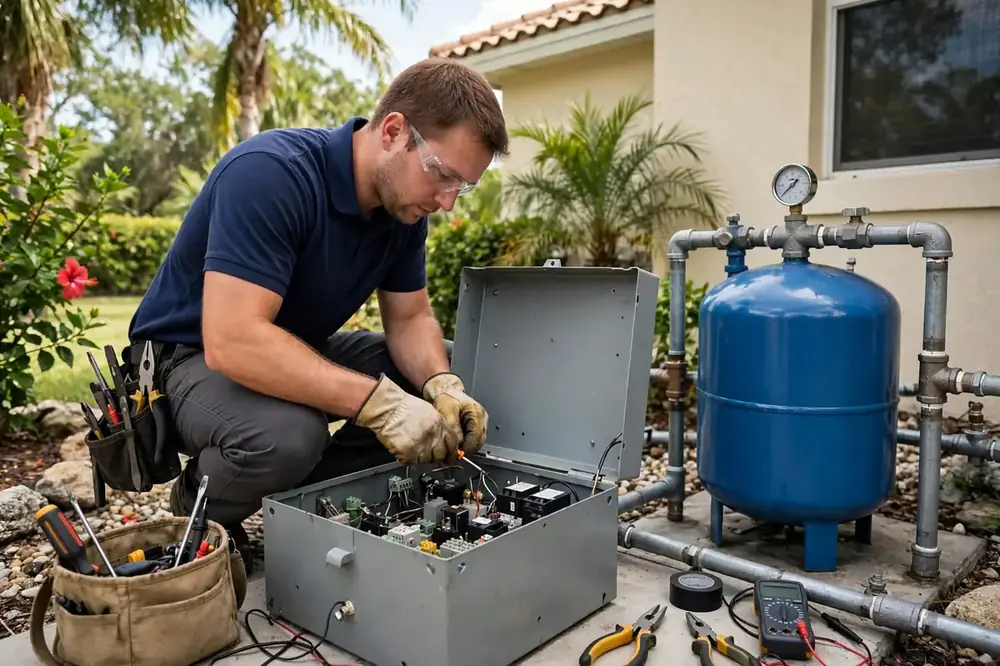
Keep the two jobs separate in the quote: a licensed well contractor drills and cases the well, an irrigation company installs pump, filtration and hookup. Ask each what their part includes and excludes, and who returns if pump and well blame each other.
Ask for iron, sulfur, sand and hardness numbers, not a verdict of “good” or “bad” water. Those numbers decide filter size, whether sequestering is needed, and how often filters need cleaning.
Walk the lawn with the installer and agree head placement before pipes go in. Heads that spray walls, drives and decks stain them from the first cycle on well water, and moving a head later costs more than aiming it right first time.
City water is the low-hassle choice: steady pressure, clean water, a monthly bill. A well is the low-monthly-cost choice: no water bill, but drilling, a pump to replace, filters to clean, and staining to manage. Reclaimed water sits between them where available, with its own schedule and filter work. The honest answer for yours comes from your bills, your water test and your lot size — in that order.
Call a pro before you drill, not after the system is in the ground. A pump installer can measure output, test water, size zones and tell you whether payback survives a pump replacement — all before any drilling invoice exists. Call again if a well system short-cycles, loses far-head pressure, or starts staining new surfaces: each symptom has a specific cause, and guessing at parts wastes more than a diagnosis. Check whether reclaimed water is available at your address in Flagler County before paying for a drilling quote — that single check can settle the whole decision.
We install and service well pumps, tanks, relays and hookups across Palm Coast — and will tell you honestly when a well does not pay off. Drilling goes to a licensed well contractor; everything after the wellhead is our work.
Call (386) 237-2983 for a well system check: output, water test, zone sizing, and a straight cost answer before drilling.
Irrigation & Sprinkler by DreamScapes — Palm Coast since 2015, 930+ customers, 24-48 hour response, 15 Hargrove Ln, Unit 5D, Palm Coast, FL 32137.
It depends on lawn size and use. A well removes the monthly water bill but adds drilling at $3,000-$7,000 plus pump replacements at $600-$1,400 fitted. City water on an irrigation meter costs about $90 a month at 10,000 gallons. Large, heavily watered lawns usually pay a well back inside one pump’s life; small lawns often never do.
Yes. Wells follow the current watering schedule, including the Phase III no-watering window of 8 a.m. to 6 p.m. A well does not exempt a lawn from the rules. See our Palm Coast watering days page for the current schedule, rather than relying on a rule quoted in an older guide.
Yes. DOH-Flagler issues construction permits and inspects wells under 6 inches in diameter, for both drinking-water and irrigation wells. Get the permit before drilling starts, and be wary of any driller who suggests skipping it.
Iron in the water oxidises as it dries, leaving orange stains wherever spray lands repeatedly — walls, driveways and pool decks. Aim heads away from hard surfaces, fit filtration matched to a water test, and consider a sequestering system where staining persists.
No. Where reclaimed water is available for irrigation, a new private irrigation well is not authorised. Check reclaimed availability at your address first, and read our reclaimed water guide for what that service means for your sprinklers.
Yes, as a hookup job: separate the city supply with proper backflow protection, wire the controller to the pump or relay, and rebalance zones to the well’s output. Keep the city meter until the well system has run clean for a full watering cycle.
Roughly 8-15 years, with iron and sand shortening that life. Short cycling, often caused by a failing tank or relay, shortens it further. That lifespan belongs in any payback calculation — a well that only pays back after its second pump is a different deal than one that pays back inside the first.