⭐⭐⭐⭐⭐930+ Happy Customer Reviews
Reclaimed water is municipal wastewater treated to at least secondary level and disinfected, then supplied for landscape irrigation instead of drinking water. In Palm Coast, retail reclaimed meter customers are not bound by the Phase III watering schedule, but the reclaimed lines must stay separate from drinking water, and the extra sediment means sprinklers need more care.
Key takeaways:
Reclaimed water is wastewater that has been treated and disinfected to a standard approved for landscape irrigation. The treatment removes solids and pathogens to at least secondary level, but it does not turn the water into drinking water. Florida utilities reuse it because it keeps treated water working instead of discharging it, and because lawns do not need potable water to stay green. About 2.5 billion gallons of reclaimed water are used in Florida every day, through 363 facilities serving 591,834 residents, according to UF/IFAS SL385. The water still carries what was in it before treatment, in smaller amounts: dissolved nutrients, dissolved salts, and fine sediment.
Yes, for irrigation. Reclaimed water is approved for watering lawns, trees, and ornamental beds, and incidental splash on skin while the system runs is not a hazard the rules treat as exposure. It is not safe for drinking, cooking, filling a pool, or washing produce, and children and pets should not drink from puddles or play in standing reclaimed water. Keep the distinction practical: the lawn can drink it, the household cannot. Pets are safe on a lawn watered with reclaimed water once it has dried, which is the normal state between cycles.
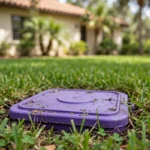
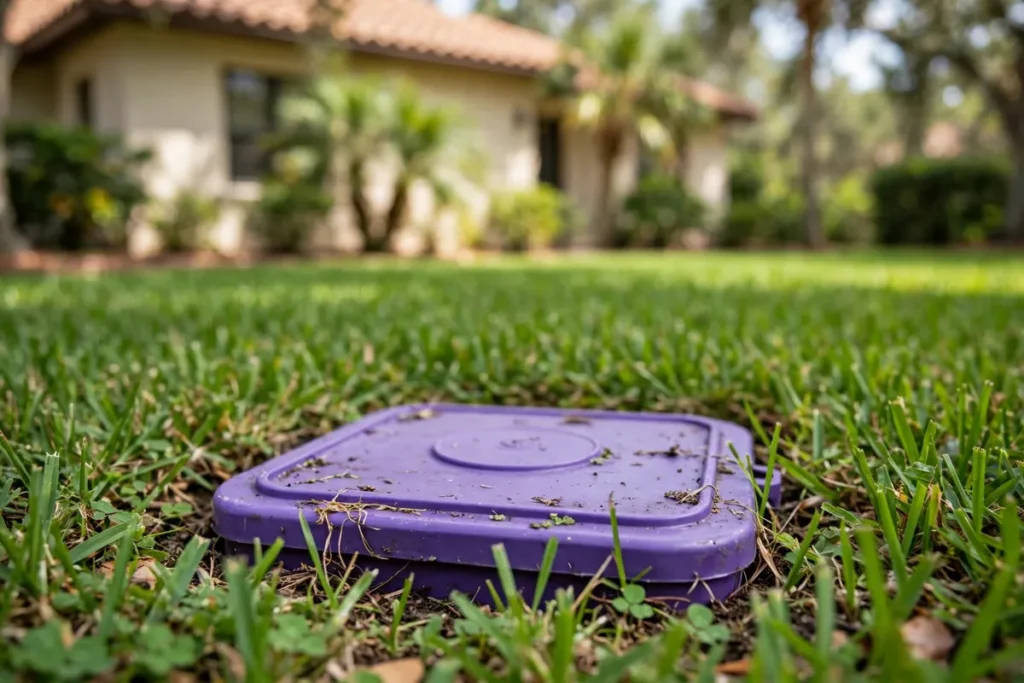
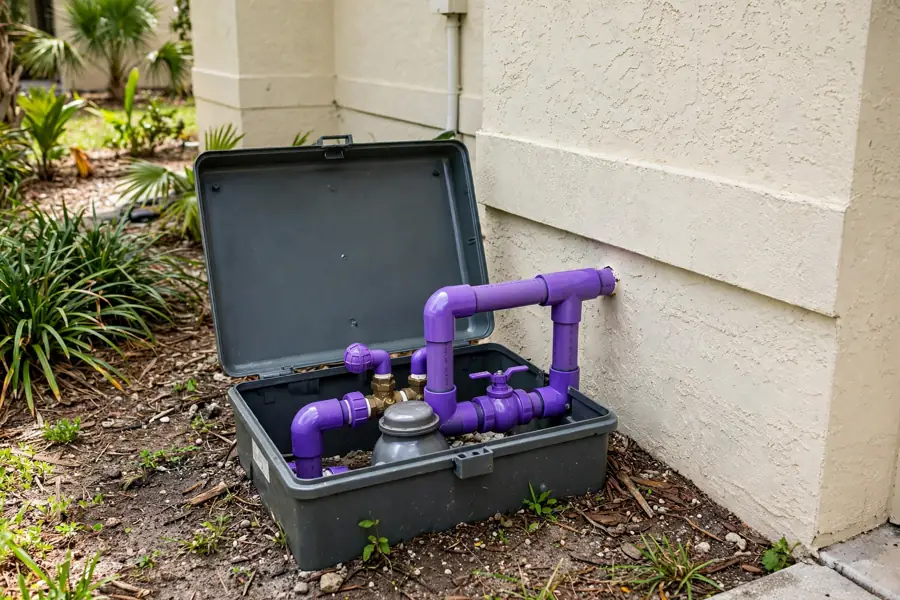
Look for purple first. Reclaimed valve box lids are purple, reclaimed pipe and tags are purple, and the purple is deliberate: it tells anyone digging or repairing the system that this line is not potable water. A second meter, separate from the drinking-water meter, is another sign, and so is a reclaimed or reuse line item on your utility bill. If none of those signs are present, your system almost certainly runs on city water or a well, not reclaimed water.
Palm Coast is a reclaimed-water city in a way most Florida towns are not: many neighborhoods were built with a second, purple system alongside the drinking-water system, so a large share of lawns here run on reclaimed water every week. The City’s reclaimed system serves areas south of the Cigar Lake Pump Station, including Town Center, Hidden Lakes, Toscana, and Grand Landings, and the Dunes Community Development District supplies Hammock Dunes. Read that as “including,” not as a complete list — new sections connect over time, and the bill or the purple pipe at your meter is the reliable test for your own home.
Retail reclaimed meter customers in Palm Coast are not bound by the Phase III watering schedule. For the current watering days that do apply to other systems, see our Palm Coast watering days page, which is kept as the site’s single source for watering rules.
The City’s reclaimed network reaches the neighborhoods south of the Cigar Lake Pump Station, including Town Center, Hidden Lakes, Toscana, and Grand Landings, according to the City of Palm Coast in May 2024. If your home sits in one of those areas, the odds are high that you have a reclaimed connection, but the purple pipe and the bill remain the proof. Homes outside the network run on city water or a private well, and the rules in this guide do not apply to them.
Hammock Dunes is supplied by the Dunes Community Development District, not the City, and its fact sheet states its rules in the strictest form: no cross-connection to potable water, wells, ponds, or neighbors’ systems; an approved backflow device on the potable supply; no hose bibs on reclaimed lines; all piping in Pantone 522C purple; no drinking or body contact; and sediment and algae not guaranteed absent. The City’s rules share the same core — separation, backflow protection, purple pipe, no hose bibs — but if you live in Hammock Dunes, follow the Dunes CDD wording for your own system, because it is the authority for your connection.
The exemption changes when you may water, not how safely the system must be built. Cross-connection protection, backflow protection, purple pipe for repairs, and the hose-bib ban all still apply in full, and a reclaimed system that violates them is a hazard even if it waters on the right day. Utilities can also set their own reclaimed hours, so “not bound by Phase III” does not mean “water any time without checking.” Your supplier’s own schedule, if it sets one, is the one to follow.
Check two things, in this order. First, the bill: a reclaimed line item means you are a retail reclaimed meter customer. Second, the meter box: purple pipe confirms it. If both are absent, assume your system follows the standard watering rules and check the watering-days page linked above.
Four rules carry the whole safety case, and all four are simple to state and easy to break by accident. First, no cross-connection: a reclaimed line must never connect to a drinking-water line, a well, a pond, or a neighbor’s system, directly or through a shared fitting. Second, backflow protection on the potable side: where a property has both supplies, the drinking-water side needs an approved backflow device so a pressure drop cannot pull reclaimed water backward into the house supply.
Our irrigation backflow preventer guide explains what that device does and why it sits where it does. Third, no hose bibs on reclaimed lines: a hose on a reclaimed line is a drinking-water accident waiting for a thirsty child, a pet bowl, or a bucket. Fourth, purple pipe for every repair: any pipe added to a reclaimed system must be purple, so the next person who digs knows what they are cutting into.
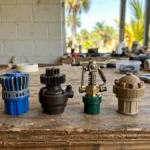
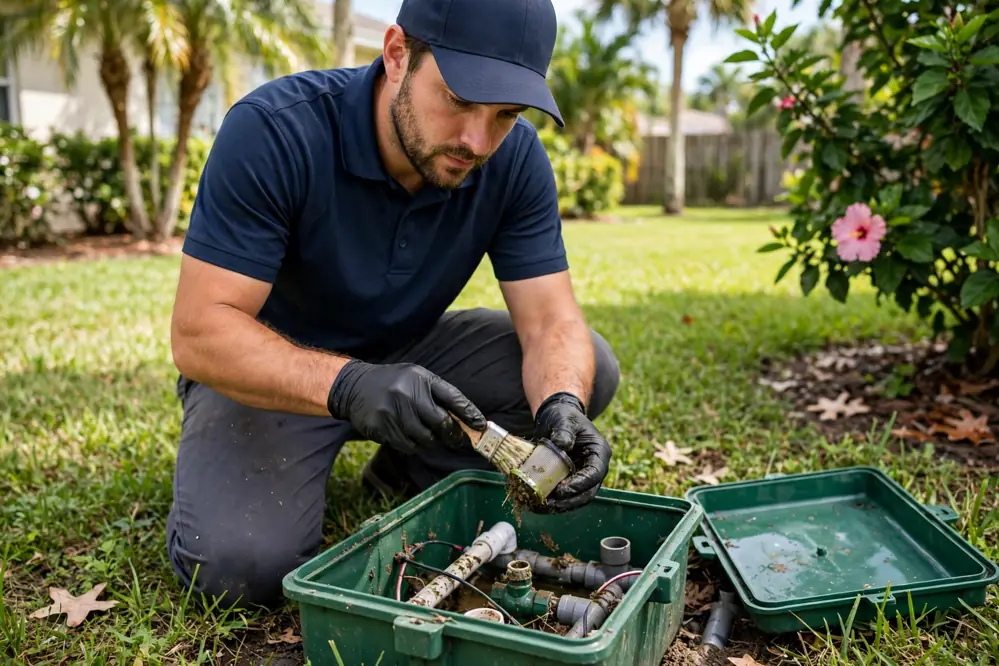
Reclaimed water clogs things. Sediment and algae that survive treatment settle in nozzle filters, narrow the openings in spray heads, and collect as grit in valves. A head that sprays weakly, fans to one side, or stops popping up on a reclaimed system is usually clogged before it is broken, and our sprinkler head won’t pop up guide walks through the checks in order. Valves suffer the same way: grit under a diaphragm keeps a valve from sealing, so a zone weeps or runs long.
Filters are the first line of defense, and on reclaimed water they are not optional extras. Add a filter where the system has none, clean the ones it has on a schedule instead of waiting for a failure, and flush heads after any repair that opens a line. Backflow testing and sprinkler head services are mentioned here in plain text only — their pages were not re-confirmed live for this build, so no link is added until they are verified.
Reclaimed water already carries nitrogen, phosphorus, and potassium, and turf can get part of its nitrogen and all of its phosphorus from it, according to UF/IFAS SL385. That means the fertilizer program written for a city-water lawn overfeeds a reclaimed lawn. Cut nitrogen and phosphorus first, then watch the lawn for a full season before adding anything back: color and growth, not the calendar, should tell you whether the cut was enough. Too much water on top of too much fertilizer also leaches nutrients below the root zone, which is the soil damage our over-irrigation guide describes in full.
Reclaimed water carries dissolved salts. Florida rain usually leaches those salts below the root zone, so most lawns handle them without trouble, but salt-sensitive ornamentals can suffer, especially in beds that stay dry between rains or sit under a roof overhang where rain never reaches. If a bed plant browns at the leaf edges while the lawn beside it stays green, salt is a candidate worth checking before disease. Flush the bed with fresh water on occasion, keep reclaimed spray off foliage where the layout allows, and choose salt-tolerant plants for beds that will only ever see reclaimed water.
Reclaimed water can leave a faint stain where spray hits walls, fences, or pool decks repeatedly, and brown patches on a reclaimed lawn have more than one cause. Check clogging first: a half-clogged head throws an uneven pattern that starves one side of its arc and soaks the other. Check salt second, in beds and along edges where spray lingers. Check fertilizer third, because a lawn overfed on top of nutrient-rich water can burn in the same pattern as a dry lawn. Work in that order — head, salt, feed — before you change the schedule, because the schedule exemption means a reclaimed lawn’s problem is rarely that it watered on the wrong day.
Three water sources, three different deals. For how the parts of any of these systems fit together, see our how a sprinkler system works guide. Reclaimed water is supplied treated for irrigation, is not bound by the Phase III schedule for retail meter customers, and needs the most filter and nozzle care. City water is the simplest to run and the cleanest, but it is billed every month and it follows the standard watering rules.
A private well removes the monthly water bill but adds a pump to maintain, and where reclaimed water is available for irrigation, a new private irrigation well is not authorized — that comparison in full, well versus city, is a separate guide we will link here once it publishes, and it is mentioned in plain text only for now.
| Source | Schedule | Water quality | Maintenance |
|---|---|---|---|
| Reclaimed | Retail meter customers not bound by Phase III; supplier may set its own reclaimed hours | Treated and disinfected; carries nutrients, salts, and sediment | Highest: clean filters, flush heads, check valves for grit |
| City | Standard watering rules apply | Potable; cleanest for heads and valves | Lowest: normal checks only |
| Well | Phase III rules apply | Often iron and sulfur; staining risk | Pump, filter, and stain care |
A reclaimed system check starts at the meter box: purple pipe present, backflow device in place on the potable side, no hose bib on the reclaimed line, and no cross-connection to a well or city line. Then every zone runs while we watch: heads that fan, mist, or fail to pop get cleaned or swapped, filters get pulled and rinsed, and valves get checked for grit that keeps them from sealing. That visit is the practical version of this guide — the same four rules, the same filter rhythm, and a schedule confirmed against your supplier, not guessed from a neighbor’s system.
We service reclaimed systems across Palm Coast every week — purple pipe checks, backflow protection, filter and nozzle cleaning, valve grit checks, and fertilizer advice for nutrient-rich water.
Call (386) 237-2983 for a reclaimed system check, usually scheduled within 24–48 hours. We have served Palm Coast since 2015, with 930+ customers, from 15 Hargrove Ln, Unit 5D, Palm Coast, FL 32137. See our irrigation system maintenance page for what a visit covers.
Reclaimed water is treated, disinfected wastewater supplied for landscape irrigation — lawns, trees, and ornamental beds. It is not drinking water, and it is not for pools, cooking, or washing produce.
Yes, for irrigation. Lawns and pets are safe on reclaimed-water turf once it has dried between cycles. Do not let children or pets drink from puddles or standing reclaimed water, and never use it for drinking or cooking.
Retail reclaimed meter customers in Palm Coast are not bound by the Phase III watering schedule. Your supplier may still set its own reclaimed hours, so check your supplier’s schedule rather than assuming there are no rules at all.
Sediment and algae in reclaimed water settle in nozzle filters and narrow head openings. Clean filters on a schedule, flush heads after repairs, and add a filter where the system has none.
Yes. Reclaimed water already carries nitrogen, phosphorus, and potassium, and turf can get part of its nitrogen and all of its phosphorus from it, according to UF/IFAS SL385. Cut nitrogen and phosphorus first, then watch the lawn for a season.
No. Hose bibs are not allowed on reclaimed lines, because a hose turns a non-potable line into a drinking-water risk for children, pets, and anyone filling a bucket or pool.
No. Where reclaimed water is available for irrigation, a private irrigation well is not authorized, according to SJRWMD. If you already have a well, it must stay separate from the reclaimed system with no cross-connection.