
⭐⭐⭐⭐⭐930+ Happy Customer Reviews
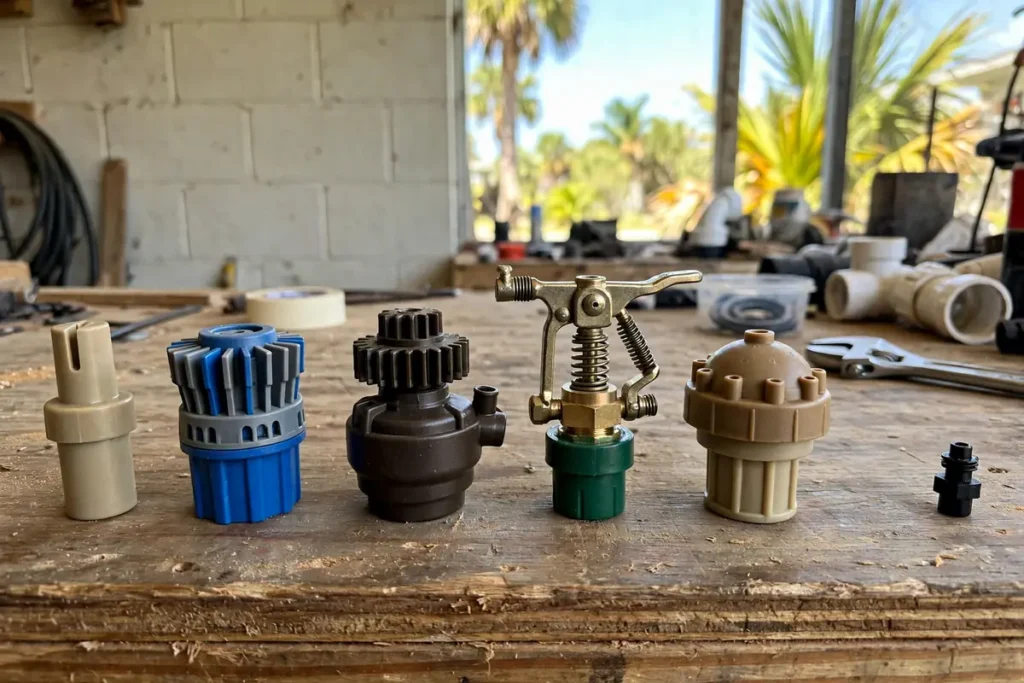
The main types of lawn sprinkler heads are fixed spray, rotary nozzles, gear-driven rotors, impact rotors, bubblers and drip emitters. Sprays suit small areas, rotors suit large lawns, and rotary nozzles use about a third of a spray’s water rate. Most Palm Coast lawns need 6-inch pop-ups.
Start with the table, then read the section for the head you are considering. Water use is the precipitation rate: how fast the head lays water down, in inches per hour. A high rate is not better. It only means the zone must run for less time to put down the same depth, and on sandy soil a fast rate can run off before it soaks in.
| Head type | Water use | Throw radius | Pressure | Best use |
|---|---|---|---|---|
| Fixed spray | 1.5–2.0 in/hr | 5–15 ft | ~30 PSI | Small strips and beds |
| Rotary nozzle | 0.5–0.6 in/hr | 10–30 ft | 40–45 PSI | Existing spray zones, sandy soil |
| Gear-driven rotor | 0.5–1.0 in/hr | 15–50 ft | 45–50 PSI | Large open lawns |
| Impact rotor | Low | 25–45 ft | ~40 PSI | Large open areas |
| Bubbler | Flood at base | 1–3 ft | Low | Trees and shrubs |
| Drip emitter | Gallons per hour | At the plant | 15–30 PSI | Beds and containers |
That is the whole choosing problem in one table: area size, water rate, pressure and height. The rest of this guide explains what each row means in a real yard.
Note: the short spray, rotor, rotary and drip overview in How Does a Sprinkler System Work? will link to this guide. This post is the full choosing guide, not a repeat of that overview.
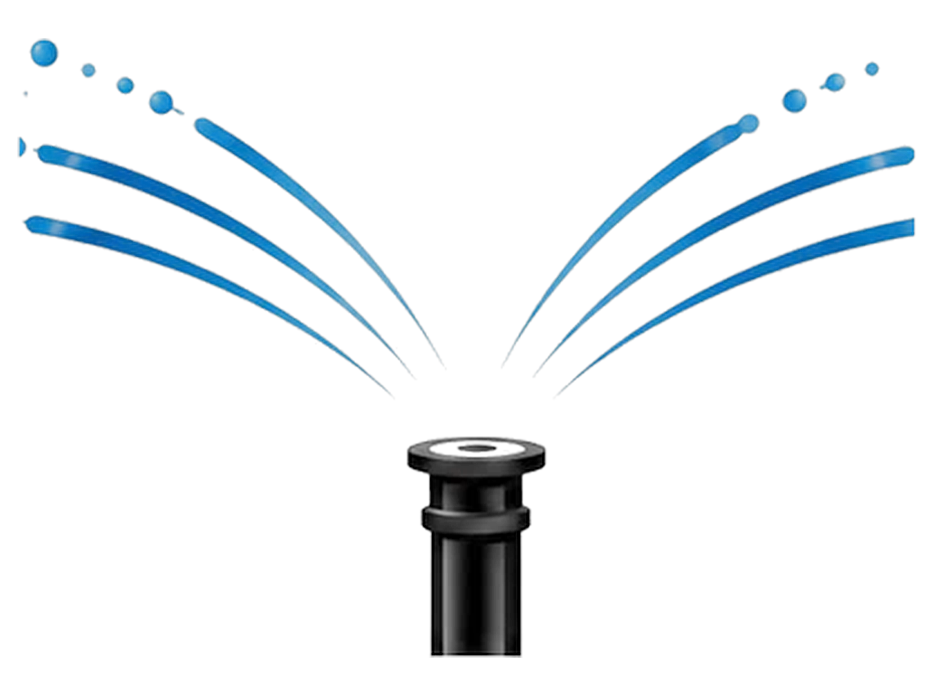
A fixed spray head pops up and throws a fan of water at a set pattern: quarter circle, half circle, full circle, or a strip pattern for a narrow side yard. Nothing rotates. The pattern is the point. On a small front strip or a tight bed, a spray head covers the shape exactly, with no water thrown past the edge it was set for.
Sprays run at about 30 PSI and throw 5 to 15 feet, putting water down at 1.5 to 2.0 inches per hour. That fast rate suits small areas because the zone finishes quickly, but it also means the zone must be timed carefully. Run a spray zone as long as a rotor zone and the strip gets several times the water it needs.
Strip nozzles deserve a mention for Palm Coast front yards. Many homes have a narrow grass strip between the sidewalk and the street, too small for a rotor and awkward for a round pattern. A strip nozzle throws a long, narrow rectangle and keeps the water on the grass instead of the concrete.
If a spray head throws short or breaks into mist, check pressure before swapping parts. A head running well below its rated pressure cannot reach its radius, and a head running well above it shatters the stream into droplets the wind carries away. Our low-pressure guide walks through the checks in order.
A rotary nozzle looks like a spray head from the outside, but it throws several slow rotating streams instead of one solid fan. The water lands at about 0.5 to 0.6 inches per hour, roughly a third of a spray head’s rate, over a 10 to 30 foot radius at 40 to 45 PSI. The streams give sandy soil time to absorb water instead of letting it sheet off the surface.
The practical win is the retrofit. A rotary nozzle fits an existing spray body, so upgrading a zone usually means swapping nozzles, not digging up bodies or re-piping. That is why rotary nozzles are the first water-saving upgrade to consider on a spray system that already covers well but runs too fast for the soil.
Rotary nozzles use about 30% less water than a standard spray nozzle for the same coverage, and they are rebate-eligible in some programs. Rebate detail lives in our automation guide.
A gear-driven rotor throws one or two streams in a slow arc, driven by gears inside the head, and covers 15 to 50 feet at 45 to 50 PSI. Its water rate of 0.5 to 1.0 inches per hour is close to a rotary nozzle’s, which is why rotors suit large turf: the zone can run longer without flooding, and the water has time to soak into sandy soil.
Rotors earn their place on open backyards and wide front lawns, where a spray head would need a dozen heads to cover the same ground. Arc and radius adjust on the head itself, so a rotor can be set to stop at a bed edge or a driveway instead of throwing past it. Set the arc with the zone running and watch where the stream actually lands, not where the dial says it should.
Rotors need pressure. At well under 45 PSI a rotor throws short and stalls, leaving dry rings between heads. If a rotor zone has weak throw, the cause is usually pressure, pipe sizing or too many heads on the zone, not the rotor itself.
An impact rotor is the old brass head with the clicking arm. Water pressure drives the arm, the arm snaps the head around a step, and the stream sweeps a large circle. Impact rotors throw 25 to 45 feet at about 40 PSI with a low precipitation rate, and they sit above ground or pop up depending on the model.
They still make sense on large open areas where looks matter less than throw: big back lots, open turf away from the house, and areas where a gear rotor’s finer mechanism would clog with sand. They are noisy, they throw a single stream that wind bends more easily than a multi-stream pattern, and they look out of place in a small front yard. For most Palm Coast lawns, a gear rotor or rotary nozzle is the better pick, and an impact rotor is the answer when the area is simply too big for either.
Not every plant wants overhead spray. A bubbler floods water at the base of a tree or shrub, covering only 1 to 3 feet at low pressure. It soaks the root zone without wetting foliage, which matters for plants that stay damp and pick up disease when sprayed from above.
Shrub heads sit on a riser above groundcover or mulch so the spray clears the planting instead of firing into it. They use spray or rotary nozzles on a taller body, and they belong in beds where a pop-up head would be buried by mulch within a season.
Drip emitters deliver water by the gallon per hour, right at the plant, at 15 to 30 PSI. For beds, hedges and containers, drip puts water where roots are and nowhere else, and it sidesteps the whole rotor-versus-spray question. Our sprinkler versus drip guide compares the two approaches for a full yard.
Choose by area size first, then by water rate. A small strip, a tight bed or a narrow side yard is spray country: the area is small enough that a fast rate finishes the job without waste. An open lawn you cross in more than a few strides is rotor country: the area is large enough that a slow rate and a long throw cover it with fewer heads and less misting.
The rule that matters most is never mix head types on one zone. A spray head puts down 2 to 4 times the water of a rotor in the same run time, so a mixed zone over-waters the spray areas and under-waters the rotor areas no matter how the timer is set. If a zone already mixes types, split it or convert one type to match the other; there is no timer setting that fixes a mixed zone.
Zone layout decides whether that rule is easy or hard to follow. Our zones guide explains how to split a yard so each zone carries one head type and one plant type.
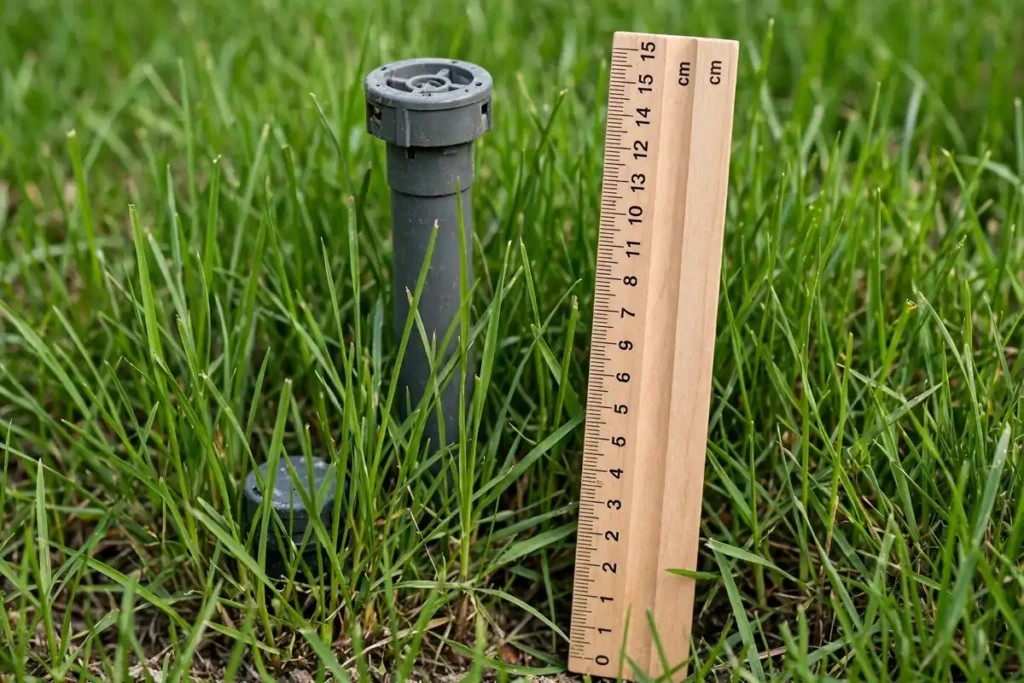
Pop-up height is the height the riser lifts above ground when the zone runs. Too short and the spray fires into grass instead of over it. Too tall and mowers clip the head. The right height follows mowing height, not the price tag.
| Pop-up height | Best for |
|---|---|
| 2-inch | Very low-cut turf only; too short for most Florida lawns |
| 4-inch | Safest choice for most lawns in general, and for short turf |
| 6-inch | Taller turf and dense groundcover |
| 12-inch | Beds and shrubs, where spray must clear planting |
Florida grass makes the choice concrete. UF/IFAS recommends mowing standard St. Augustine grass at 3.5 to 4 inches, and dwarf cultivars Captiva, Delmar and Seville at 2.5 inches. A 6-inch pop-up clears standard St. Augustine where a 4-inch head gets blocked by thick growth, which is why most Palm Coast lawns need 6-inch pop-ups. The same test applies to Zoysia and Bahia: measure your mowing height, then pick a pop-up that rises clearly above it.
A head that stays down or sprays sideways is not always a height problem, but height is the first thing to check before assuming a part has failed. Our pop-up head guide covers the other causes, from sand in the riser to a tired spring.
Walk the yard and assign a head to each area, not one head to the whole property. The small front strip between sidewalk and street gets spray heads with strip nozzles. The open backyard gets gear rotors. Beds and the base of trees get bubblers or drip. Along driveways, set arcs to stop at the concrete and keep spray off the surface, where it stains and wastes water.
Sandy soil pushes the choice toward slower water. Palm Coast and Flagler County homes share fast-draining sand, so a rotary nozzle or rotor that lays water down slowly usually beats a spray head that lays it down fast, even where the area is small enough for spray. Slopes push the same way: slow water soaks in instead of running to the street.
For the current watering days for your address, see our Palm Coast watering-days guide. This post does not restate the schedule; that guide is the single source for it.
A replacement head costs $10 to $25 as a do-it-yourself part, and $75 to $125 installed per head. The installed figure covers the visit, the part, the arc and radius setup, and a zone run to check coverage, not just the head itself. Swapping a whole zone of nozzles to rotary nozzles lands at the low end per head because the bodies stay in the ground.
Those are the same ranges as the live Irrigation System Components post, so the site stays consistent.
For a full repair visit with several heads, valves or wiring work, see our repair cost guide for the wider picture.
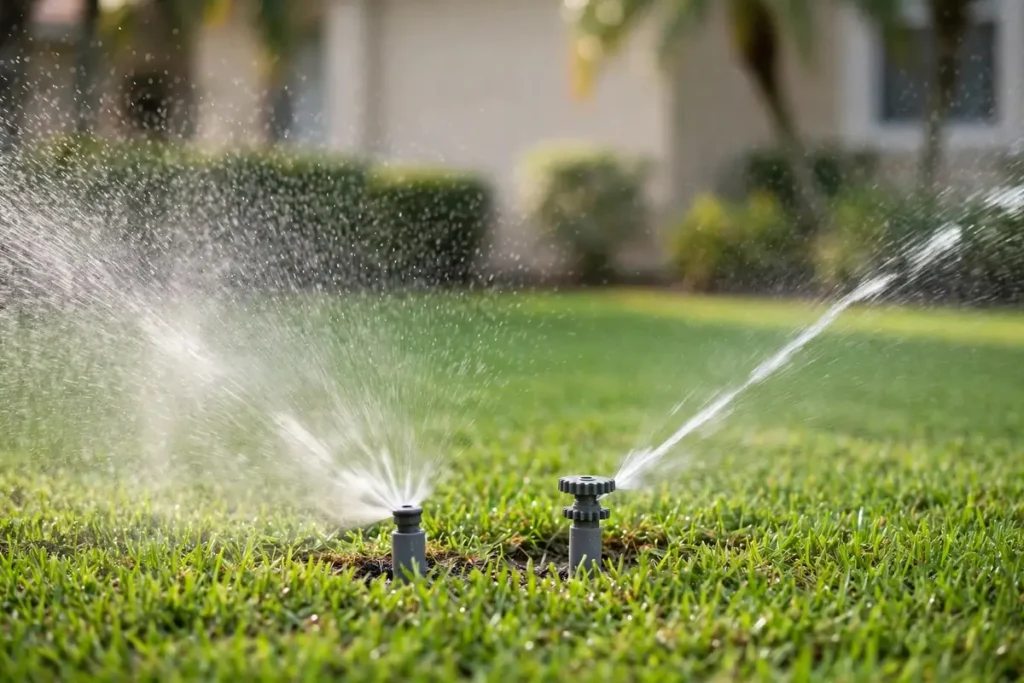
Spacing matters more than head brand. The standard is head-to-head coverage: each head’s throw should reach the next head, so the overlap evens out the pattern. A head spaced at its full radius with no overlap leaves dry rings halfway between heads, and no timer setting fixes a gap in coverage.
Wind and corners change the spacing in practice. On a windy side of the yard, heads sit a little closer together so the pattern still overlaps when the stream bends. In a corner, a quarter-circle head covers the corner itself while the heads along each edge carry the rest. Check spacing by running the zone and watching where water actually lands, then move a head before blaming the timer.
A mixed zone cannot be timed right. The spray areas drown while the rotor areas stay dry, and the homeowner usually answers by running the zone longer, which drowns the spray areas further. Convert the zone to one head type or split it.
A 4-inch head is the safe default in most of the country, but on standard St. Augustine mowed at 3.5 to 4 inches it fires into the grass. The lawn looks under-watered, the heads get blamed, and the real fix is a 6-inch pop-up that clears the turf.
Spray that lands on a driveway or sidewalk waters nothing, stains the surface, and runs to the street. Set the arc and radius with the zone running, and use a strip nozzle along narrow edges instead of letting a round pattern overshoot.
| If your area is… | Pick… |
|---|---|
| A small strip or tight bed | Fixed spray, or a strip nozzle for narrow edges |
| An open lawn | Gear-driven rotor |
| An existing spray zone that runs too fast | Rotary nozzles on the existing bodies |
| Beds, trees or shrubs | Bubbler, shrub head or drip |
| Tall turf that blocks short heads | 6-inch pop-up |
Call a pro when coverage stays patchy after the heads are matched, when pressure reads well outside the ranges in the table, or when a zone needs splitting to separate head types. A coverage audit runs each zone, checks pressure at the head, and resets arcs and radii, and it usually finds the problem in one visit rather than through a season of guessing.
We install, upgrade and repair sprinkler heads across Palm Coast and Flagler County through our sprinkler head services. A head upgrade swaps spray nozzles for rotary nozzles where the soil needs a slower rate, and a coverage audit resets arcs, radii and pop-up heights across the whole system.
Call (386) 237-2983 for a visit within 24–48 hours. Irrigation & Sprinkler by DreamScapes has served Palm Coast since 2015, with 930+ customers, from 15 Hargrove Ln, Unit 5D, Palm Coast, FL 32137.
The main types of lawn sprinkler heads are fixed spray heads, rotary (multi-stream) nozzles, gear-driven rotors, impact rotors, bubblers and drip emitters. Sprays throw a set fan pattern, rotors throw a rotating stream over a larger area, rotary nozzles throw slow multi-streams from a spray body, bubblers flood at the base of a plant, and drip emitters deliver water by the gallon per hour at the plant.
A spray head throws a fixed fan at 1.5 to 2.0 inches per hour over 5 to 15 feet at about 30 PSI. A gear-driven rotor throws a rotating stream at 0.5 to 1.0 inches per hour over 15 to 50 feet at 45 to 50 PSI. Sprays suit small areas and finish fast; rotors suit large lawns and water slowly enough for sandy soil to absorb.
No. A spray head puts down 2 to 4 times the water of a rotor in the same run time, so a mixed zone over-waters the spray areas and under-waters the rotor areas no matter how the timer is set. Convert the zone to one head type or split it into two zones.
6-inch pop-ups for standard St. Augustine grass. UF/IFAS recommends mowing standard St. Augustine at 3.5 to 4 inches, and a 6-inch head clears that height where a 4-inch head gets blocked by thick growth. Dwarf cultivars Captiva, Delmar and Seville are mowed at 2.5 inches, so a 4-inch head can work there.
Drip emitters use the least water overall because they deliver gallons per hour right at the plant and nowhere else. Among overhead lawn heads, rotary nozzles use the least, at 0.5 to 0.6 inches per hour, about 30% less than a standard spray nozzle for the same coverage.
Yes, in most cases. A rotary nozzle fits an existing spray body, so upgrading a zone usually means swapping nozzles, not digging up bodies or re-piping. Check that the zone runs at 40 to 45 PSI, the rotary nozzle’s operating range, before swapping a whole zone.
Space heads so each head’s throw reaches the next head. That head-to-head overlap evens out the pattern and avoids dry rings halfway between heads. On a windy side of the yard, space them a little closer so the pattern still overlaps when the stream bends.