⭐⭐⭐⭐⭐930+ Happy Customer Reviews
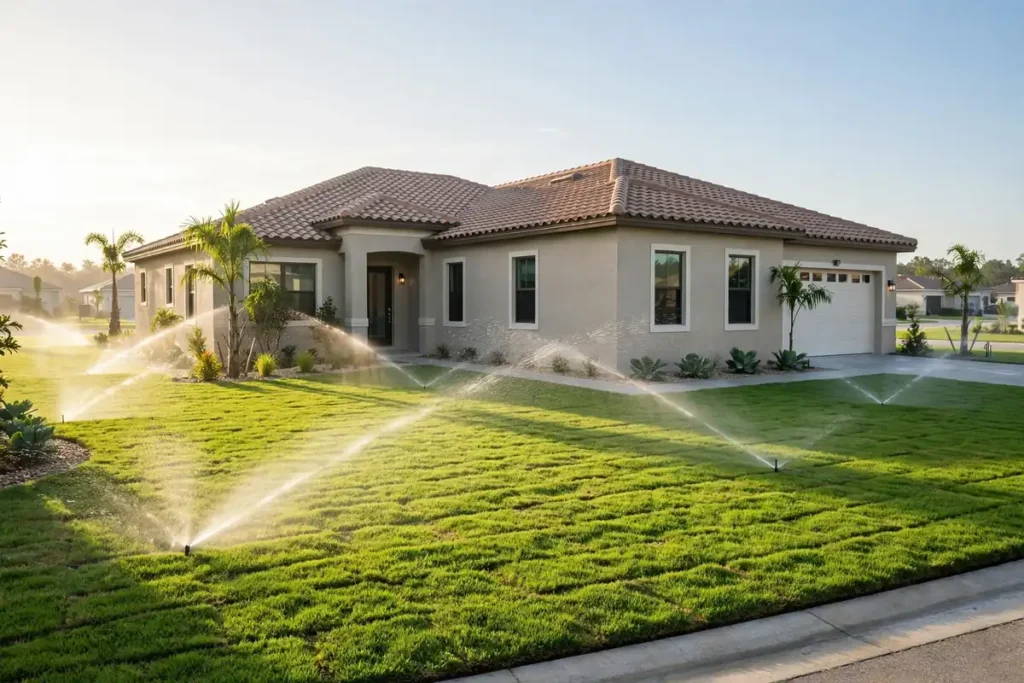
Most new Palm Coast homes come with a basic in-ground sprinkler system, but builder-grade systems are often under-zoned and set up for new sod only. Before closing, run every zone, check for overspray and dry spots, confirm the rain sensor works, and get the zone map and backflow record.
Key takeaways:
A new Palm Coast home usually comes with a basic in-ground lawn sprinkler system: a controller in the garage, zone valves, spray or rotor heads across the turf, and a backflow device where the irrigation line meets the drinking-water supply. The system is sized for the lot as built, with zones drawn around the lawn, beds and side strips the builder landscaped. On most lots, turf gets spray or rotor coverage, beds get sprays or drip, and narrow side yards get whatever head fits.
The controller is the part buyers notice least and use most. A basic timer runs fixed programs, while a weather-based or soil-moisture controller adjusts run times to conditions. Florida law requires a working rain sensor on automatic systems installed after May 1, 1991 (s. 373.62), so a compliant new system should already have one — but “installed” and “working” differ, and the walk-through below tests it. Our smart irrigation controllers guide explains what the upgrade buys you.
What it rarely includes is just as useful: a zone map in the controller, a separate written irrigation warranty, or a backflow test record. Those gaps are normal — and exactly what the documents section below asks you to collect.
Builder-grade systems often fall short in the same handful of ways, none of which shows up on a listing sheet. The most common is too few zones: one zone across a sunny front lawn and a shaded side yard cannot water both correctly, so one area stays wet while the other dries out. Mixed heads on one zone do the same in a different form — sprays lay water down two to four times faster than rotors, so a mixed zone always over-waters part of itself.
Head height is the second common miss. WaterSense calls for pop-ups at least 4 inches tall, but standard St. Augustine in Florida is mowed at 3.5 to 4 inches (UF/IFAS), so a 4-inch head often fires straight into thick turf. That is why 6-inch pop-ups beat the 4-inch minimum on most Palm Coast lawns: the spray clears the grass instead of getting trapped in it. If heads disappear into the lawn on your walk-through, note it — it is a real coverage fault, not cosmetic.
The third pattern is spray where it does not belong: strips under 4 feet wide, slopes steeper than 4:1, and heads aimed at driveways, sidewalks and walls. WaterSense says those strips and slopes should get drip, not spray, and overspray leaving the property fails outright. A timer without smart features rounds out the list: a fixed new-sod program keeps running long after the lawn is established. None of this means any particular builder cut corners — these are patterns buyers often find.
Walk the system with the builder or your inspector and run every zone, one at a time, while you watch. The table below is built on the EPA WaterSense New Home Irrigation Audit (v1.1) — use it as the definition of a good system, and treat anything that fails as a punch-list item.
| Check | What passes |
|---|---|
| Leaks | System runs without leaks at any head, valve or fitting |
| Overspray | No runoff or overspray leaving the property onto driveways, sidewalks or the street |
| Coverage | Distribution uniformity (lower quarter) of 65% or more on a catch-cup test |
| Rain shutoff | Rain or soil-moisture sensor installed and working |
| Controller | Weather-based or soil-moisture controller, keeps programs without battery, zone-specific programs, percent adjust |
| Heads | Pop-ups at least 4 inches tall with matched precipitation on each zone |
| Where sprays go | Sprinklers only on turf; none on turf strips under 4 feet wide or slopes steeper than 4:1 — use drip there |
| Drip zones | Pressure regulator, filter and flush ends fitted |
| Schedule | Two schedules posted at the controller: new-sod grow-in and established lawn |
| Pressure | Each zone within 10% of the head maker’s recommended pressure |
Two practical tests catch most faults in ten minutes. First, the catch-cup test: set cups across a zone, run it, and compare depths — uneven cups mean uneven coverage, usually spacing, a clogged nozzle or mismatched heads. Second, the rain-sensor test: spray the sensor with a hose and confirm the controller pauses the system; a sensor that never trips is decoration. Our types of sprinkler heads guide helps you name what you are looking at while you walk.
Four documents turn a walk-through into a record you can use later. Ask for the zone map, which shows which heads belong to which valve and station; the controller manual, so you can change programs without guessing; the backflow test record, which proves the device protecting your drinking water was tested; and the irrigation warranty terms in writing, including duration and exclusions. If the builder cannot produce one, get the gap noted in writing before closing — chasing a zone map after move-in is far harder.
Keep them where the next person can find them: inside the controller cover or in the home file. A technician with a zone map diagnoses a fault in one visit; without it, the first visit is spent tracing wires. Our irrigation backflow testing guide explains what that test record should show.
New sod is why builder systems are programmed the way they are — and why that program must change. Fresh sod needs frequent, shallow watering while roots establish, then deeper, less frequent watering once it takes hold. Leaving the grow-in program running keeps roots shallow, invites fungus and keeps the bill high.
Do not work the schedule out from memory or a generic guide. Follow the current schedule on our Palm Coast watering days page, which carries the Phase III grow-in schedule and the established-lawn schedule to switch to afterwards. After the first 60 days, reset the controller and re-check coverage: heads that cleared short new sod may now be blocked by taller turf, which is when 6-inch pop-ups earn their keep.
Not every upgrade pays, and the order matters more than the list. The table below ranks the upgrades buyers usually get value from first.
| Upgrade | Why it pays | Priority |
|---|---|---|
| Smart controller | Adjusts run times to weather instead of running a fixed new-sod program all year | First |
| Rotary nozzles on spray zones | Slower application suits sandy soil and cuts runoff | First |
| 6-inch pop-ups | Clear standard St. Augustine mowed at 3.5 to 4 inches where 4-inch heads get blocked | First |
| Drip for beds and narrow strips | Replaces spray on strips under 4 feet wide and steep slopes where spray wastes water | Second |
| Extra zones | Splits sunny/shaded areas, or turf and beds, one zone cannot water evenly | Second |
Start with the controller and the heads: they change how the whole system behaves. Add zones only where the walk-through proved one zone cannot cover two areas — the most expensive fix here, and one that should follow evidence, not a hunch. Our irrigation zones guide explains how zone count follows head demand and lot layout.
Most new Palm Coast lots arrive on one of three supplies, and the subdivision usually decides it for you. City water is simplest: steady pressure, clean water, a monthly bill. A private well removes the bill but adds a pump, a permit and, often, iron staining. Where reclaimed water serves the subdivision, it must be used instead of well or city water, according to the City’s building handouts — and it brings its own schedule exemption and filter work.
Do not let the supply question wait until after closing. Ask which supply serves the lot, whether a well permit or reclaimed connection is in place, and what the monthly cost looks like. Our irrigation well vs city water guide compares the three options in full.
According to the City’s building handouts (2009-2010 handouts, not current law), Palm Coast adds its own items: lots under 1/2 acre with St. Augustine or zoysia must have an automatic underground system before the final certificate of occupancy; every system needs a soil-moisture device or smart controller; the controller must be programmable by the minute with battery backup or non-volatile memory; mainlines need 18 inches of cover, laterals 12 inches; heads must sit at least 12 inches from the house; and where reclaimed water serves the subdivision, it must be used instead of well or city water. Irrigation is usually part of the building permit with a licensed irrigation contractor named. Treat these as questions for the builder and the City, not settled current law — 2009-2010 handouts may have been superseded.
Do not take the rain sensor on trust. With the controller set to run, spray the sensor with a hose for about 30 seconds: a working sensor pauses watering, resuming after it dries. If nothing pauses, the sensor is disconnected, bypassed or dead — a punch-list item, since Florida law requires a working sensor on automatic systems installed after May 1, 1991 (s. 373.62).
A new-home sprinkler inspection runs every zone, tests the rain sensor, checks for leaks and overspray, measures coverage with catch cups, and confirms both controller programs are posted. It ends with a written punch list for the builder’s warranty team.
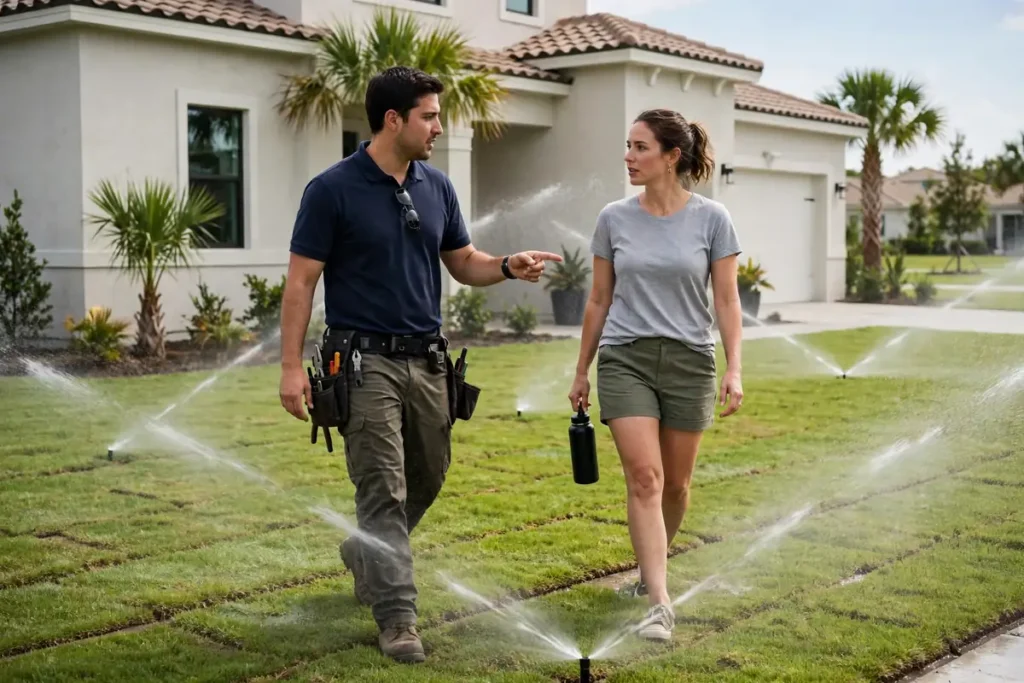
Hand the punch list to the builder in writing and ask for a re-test date, not just a promise. After fixes, re-run the affected zones and confirm the documents arrived. Faults found at the walk-through are the builder’s to fix; faults found a year later, without a record, are usually yours.
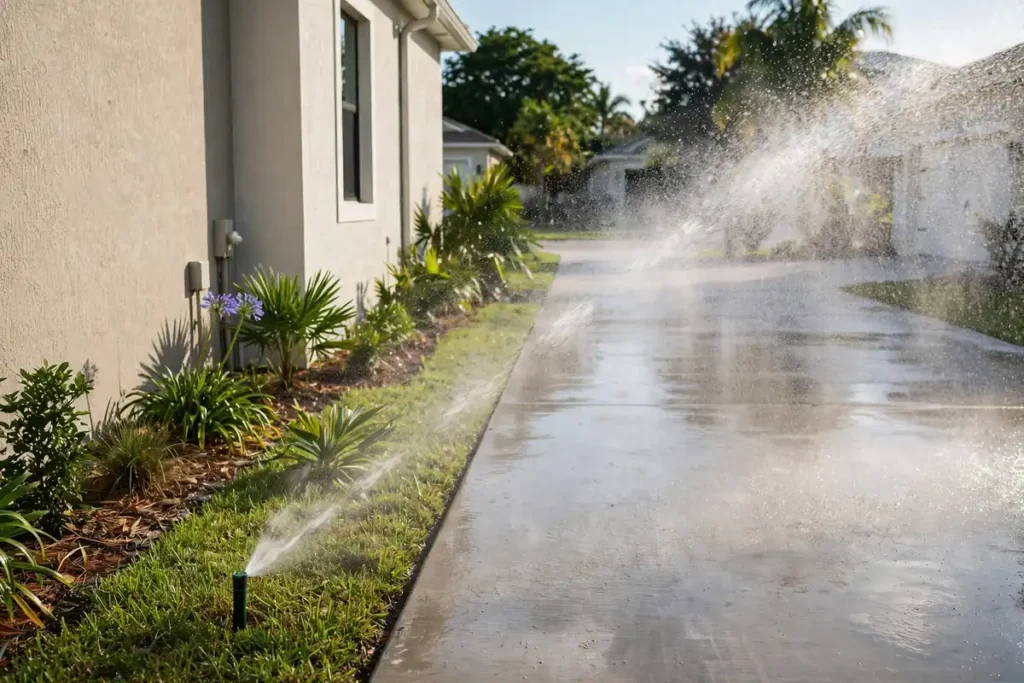
Ask whether irrigation faults go to the builder’s warranty team, the irrigation subcontractor, or you directly — and get the answer in writing. The wrong assumption costs weeks when a valve fails in the first summer.
New sod is short. Ask whether heads, zones and run times still work when St. Augustine reaches its normal 3.5 to 4 inch mowing height, or whether heads will need raising in year one.
Ask who resets the controller from the grow-in program to the established-lawn schedule, and when. If the answer is you, get the established-lawn program in writing at closing — see the current schedule on the Palm Coast watering days page rather than guessing it.
Most new homes come with a workable lawn sprinkler system, not a finished one. The walk-through is your chance to find the gaps — too few zones, short heads in tall turf, spray on concrete, a dead rain sensor — while the builder still has to fix them. Bring the WaterSense checklist, run every zone, and leave with the zone map, manual, backflow record and warranty in hand. The upgrades that pay first are the smart controller, rotary nozzles and 6-inch pop-ups.
Call a pro when the walk-through shows a pattern you cannot explain: every zone weak, water pooling where no head sprays, or a controller that will not hold a program. A technician can measure pressure per zone, run a catch-cup test and tell you whether the fault is design, installation or a single part. Our irrigation system design guide covers redesigns where the builder layout cannot be fixed by adjustment alone.
Buying a new-build home in Palm Coast? We inspect builder sprinkler systems before closing: every zone run, rain sensor tested, coverage measured, and a written punch list for the builder. See our sprinkler and irrigation installation services for new-home inspections.
Call (386) 237-2983 to book a new-home sprinkler inspection before your walk-through — or after it, for a second opinion on the punch list.
Irrigation & Sprinkler by DreamScapes — Palm Coast since 2015, 930+ customers, 24-48 hour response, 15 Hargrove Ln, Unit 5D, Palm Coast, FL 32137.
Most new Palm Coast homes come with a basic in-ground lawn sprinkler system, but it varies by builder and lot. Confirm at the walk-through what is included — zones, heads, controller and rain sensor — and get it in writing rather than assuming the listing covers it.
Run every zone and check for leaks, overspray leaving the property, dry spots and heads blocked by turf. Test the rain sensor with a hose, check coverage with catch cups, and confirm the controller holds both a grow-in and an established-lawn program.
Follow the current schedule on the Palm Coast watering days page, which carries the Phase III grow-in schedule for new sod and the established-lawn schedule to switch to after the first 60 days. Do not work it out from a generic guide — the current schedule governs.
Usually coverage, not run time: heads blocked by tall St. Augustine, mixed heads on one zone, a zone stretched too far, or a dead rain sensor masking a pressure fault. Run a catch-cup test and check each head’s throw before adding minutes to the program.
Yes, where the controller, water supply and valve layout allow it. Adding a zone splits areas one zone cannot water evenly — sunny versus shaded, or turf versus beds — but it is the most expensive fix here, so add it on walk-through evidence, not a hunch.
Often, but the terms vary by builder and are rarely spelled out for irrigation separately. Get the irrigation warranty terms in writing before closing, including how long coverage lasts, what it excludes, and who to call for a fault.