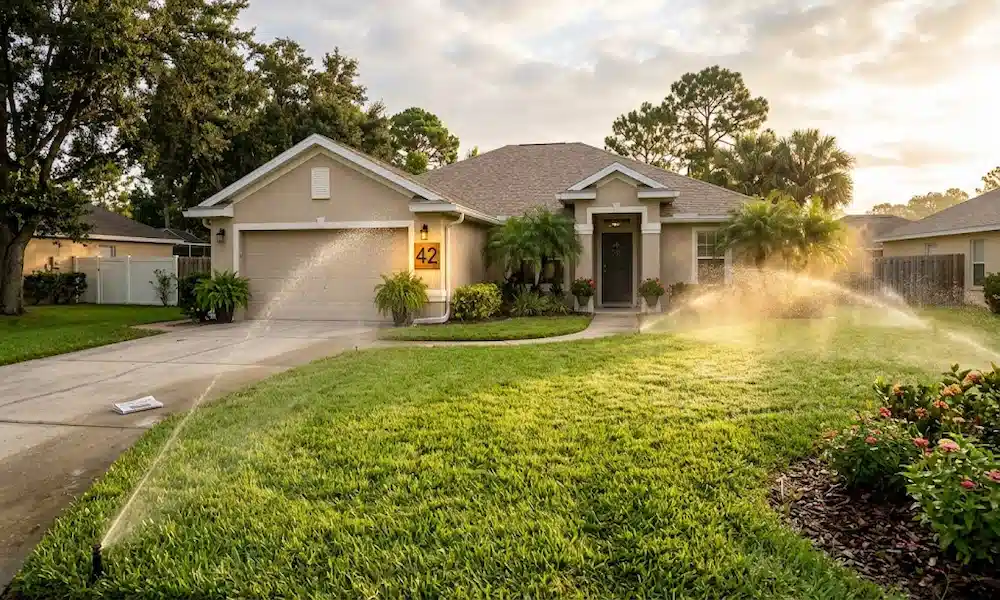
A new sprinkler system in Palm Coast usually runs $2,800 to $6,500 installed on a standard quarter-acre lot. A small front-yard-only setup starts closer to $1,800. Half-acre properties and larger typically pass $8,000.
That is a wide spread, and there is a reason for it. A sprinkler system is not one product with one price. It gets built zone by zone, and the zone count depends on lot size, water pressure, where your beds sit, and whether you water from the meter or a well.
Here is how the number is actually put together, and what pushes it up or down in Flagler County.
Contractors price a residential system one of two ways: by irrigated square footage, or by zone.
Across the U.S. in 2026, in-ground sprinkler installation averages $0.90 to $1.70 per square foot of irrigated area, or about $600 to $1,300 per zone. Those figures hold up well here. Our sandy ground trenches easily, which keeps labor at the lower end compared with rocky or clay-heavy markets, but coastal lots often need extra zones to handle wind exposure and mixed landscaping.
A realistic planning figure for most homes in this area is $800 to $1,100 per zone — valve, wire, pipe, heads and labor included.
A zone is one group of heads that runs at the same time off a single valve. Your supply can only push so many gallons per minute, so heads have to be split into groups that fit the pressure and flow you actually have.
Every zone you add brings its own hardware and labor:
That is why two houses on the same street get very different quotes. A yard broken up by a driveway, a pool cage and planting beds needs more zones than an open rectangle of turf at the same square footage. All of that gets mapped before anyone digs — our irrigation system design page walks through how.
| Project | Installed Cost (2026) | Notes |
|---|---|---|
| Small yard, 3 zones | $1,800 – $3,500 | Front lawn only, city water |
| Quarter acre, 4–6 zones | $2,800 – $6,500 | Most Palm Coast homes land here |
| Half acre, 7–9 zones | $6,000 – $10,000 | Larger lots with mixed beds |
| One acre or more, 10+ zones | $10,000 – $20,000 | Acreage and HOA common areas |
| Each additional zone | $600 – $1,300 | Valve, wire, pipe and heads |
| Drip zone for beds | $300 – $1,200 | Added to an existing controller |
| Smart controller upgrade | $150 – $600 | Weather-based timer or rain sensor |
| DIY materials only, 4 zones | $1,200 – $2,500 | Parts only — no labor or permit |
Three local conditions move a quote more than anything else.
A large share of homes in Flagler County irrigate from a shallow well rather than the meter. If your well and pump are already in place and healthy, that is money saved every month once the system is running.
If you are starting from nothing, budget for it. A shallow irrigation well in Florida generally runs $1,500 to $6,000 depending on depth and flow, and pump installation typically falls between $1,000 and $4,000. An undersized or tired pump is also the most common reason a brand-new system underperforms: heads mist instead of spray, and the back zone never fully wets. That side of the job is covered on our sprinkler pump services page.
Palm Coast sand is easy to trench, which keeps installation labor reasonable. It also drains fast, and that is where cost creeps back in. Water sprayed across the top of a planting bed can slip past the root zone before the plant uses any of it.
The answer is not more sprinkler heads. It is drip or micro-spray in the beds on a separate zone, which adds a few hundred dollars up front and saves considerably on water and replacement plants. If that distinction is new to you, our post on sprinkler systems vs irrigation breaks it down.
The St. Johns River Water Management District has a Phase III Extreme Water Shortage order covering Flagler County. Landscape irrigation is limited to one day per week, watering is prohibited between 8 a.m. and 6 p.m., and each zone is capped at three-quarters of an inch and one hour of run time on your assigned day. Private wells are included.
That cap changes what a system has to do. With one run a week, coverage has to be right the first time. A budget install that throws a quarter of its water onto the driveway is not a minor waste any more — it is a quarter of the week’s water gone. Cutting a zone to save $700 is usually the most expensive line on the sheet.
Parts for a four-zone system run roughly $1,200 to $2,500: pipe, valves, wire, heads, a controller and a backflow preventer. Add a trencher rental and a permit, which generally falls between $35 and $200.
On paper that is a 40 to 50 percent saving. What it tends to cost instead:
DIY makes sense for adding a drip line to a controller you already have. For a full system with a backflow device and a permit, the labor is where the value sits. Our sprinkler & irrigation installation page covers what a professional install includes, and how it works explains what happens on a first visit.
Not every underperforming system needs replacing, and most do not. Before you price a new install, have the existing one looked at.
Budget for upkeep either way. A yearly backflow test, a seasonal tune-up and the odd head swap keep a system efficient for years — that is what an irrigation maintenance plan is for. Running an HOA, retail plaza or multi-family site? Pricing works differently at that scale, so start with commercial irrigation services.
Every figure above is a planning range. The real price comes from your water source, a pressure reading and the shape of your lot — which takes a site visit, not a phone estimate.
Irrigation is all we do. No mowing, no pest control, no landscape crews — just sprinkler and irrigation work, which is why we can usually be at your property within 24 to 48 hours. We’ve served 930+ customers since 2015 across Palm Coast, Flagler Beach, Bunnell, Palm Harbor and Ormond Beach, and hold a 4.5-star Google rating. Read what customers say on our reviews page, or learn more about our team.
Irrigation & Sprinkler 15 Hargrove Ln, Unit 5D, Palm Coast, FL Request service →
Most quarter-acre homes fall between $2,800 and $6,500 installed, roughly $800 to $1,100 per zone. A three-zone front-yard system starts near $1,800; half-acre properties usually run $6,000 to $10,000.
Between $600 and $1,300 installed. That covers the valve, wire run, pipe and the 5 to 10 heads that zone carries. Rotors cost more per head than fixed sprays but cover more ground, so fewer are needed.
Usually 4 to 6. Yards split by a driveway, pool cage or heavy planting beds need more, because each area has a different water requirement and can't share a run time with turf.
Once it's in, yes — you aren't paying metered water to irrigate. Getting there costs money though: a shallow irrigation well in Florida runs about $1,500 to $6,000, and pump installation another $1,000 to $4,000. If you already have both and the pump holds pressure, you're ahead.
Parts for four zones run $1,200 to $2,500, plus a $35 to $200 permit. What catches most DIY installs is sizing zones beyond the available pressure and getting the backflow preventer wrong. Adding a drip line to an existing controller is a fair weekend job; a full system usually isn't.
Repair, almost every time. Heads, valves and cracked pipe are routine fixes. Replacement makes financial sense once a system is past 20 years old and the pipe and wiring are failing in more than one place.